Get a webhook when a run finishes
Kindgi signs each request with a secret that your receiver knows too. The secret lives with your other secrets, and the endpoint refers to it by name: Kindgi never stores it with the endpoint.
1. Store a signing secret
Section titled “1. Store a signing secret”A signing secret is whsec_ and the base64 of at least 24 random bytes.
Generate one:
import { generateWebhookSecret } from '@kindgi/sdk/webhooks';
console.log(generateWebhookSecret());
from kindgi import webhooks
print(webhooks.generate_secret())Store it as a secret, under a name (the CLI asks for the value and doesn't echo it):
kindgi secrets set ACME_WEBHOOK_SECRET --env=local --scope=tenant --app Set ACME_WEBHOOK_SECRET at tenant in local, in your app's env file.In development, --app writes it to your app's own env file, .env.local,
where your receiver reads it, and Kindgi reads it there too. Without --app
it would go to Kindgi's own .kindgi/secrets.env, which your app doesn't
load (Keep local values in env files). In a deployment, store it in
that deployment's secrets store, under its environment's name (see
kindgi secrets). Your receiver needs the
same value, from its own configuration.
2. Register the endpoint
Section titled “2. Register the endpoint”There's no CLI command for webhook endpoints; register one from your app (or any HTTP client) with the client:
const endpoint = await kindgi.webhookEndpoints.create({ url: 'http://localhost:8787/hooks/kindgi', events: ['run.finished'], secretRef: { envName: 'local', name: 'ACME_WEBHOOK_SECRET' }, filter: { flowIds: ['acme.review-order'] }, // optional});console.log(endpoint.endpointId, endpoint.url);5c1d2267-4dc8-4bd6-81e8-940e620405ea http://localhost:8787/hooks/kindgiendpoint = kindgi.webhook_endpoints.create( url="http://localhost:8788/hooks/kindgi", events=["run.finished"], secret_ref={"envName": "local", "name": "ACME_WEBHOOK_SECRET"}, filter={"flowIds": ["acme.review-order"]}, # optional)print(endpoint.endpoint_id, endpoint.url)07fec45a-f938-4694-8ac3-f72f38a938a4 http://localhost:8788/hooks/kindgi-
urlis your receiver. Use https in production; plain http is for development. Inkindgi dev,localhostreaches your machine, not the runtime's container. Outside development the receiver must be on a public address. A self-hosted runtime whose receiver is on its own private network (the same VPC or compose network) setsKINDGI_WEBHOOK_PRIVATE_NETWORKS=allow. That opens RFC 1918, CGNAT and IPv6 unique-local addresses, still over https only. Loopback and the cloud metadata addresses stay refused. A URL the deployment refuses gets400 webhook-url-refused, with the reason:The deployment refuses this URL: private network addresses are not allowed. -
events:run.finished, andimprovement-pass.finishedandapproval.requested, both below. -
secretRefnames the secret: the environment it's in (localin development) and its name. Kindgi checks that it exists and is strong enough, and keeps only the name:{"error":{"code":"webhook-secret-not-found","message":"No secret \"NOPE_SECRET\" in \"local\": store it first, then register the endpoint",…}} -
filternarrows which runs reach the endpoint:flowIds(any version of these flows),projectId, andincludeDryRuns(dry runs are left out unless it'strue). Without a filter, every run you start does.
Only runs your app or the CLI started send run.finished; the runs inside
them (an agent step's turn) don't.
3. What your endpoint receives
Section titled “3. What your endpoint receives”When a run of acme.review-order ends, your URL gets a POST:
POST /hooks/kindgicontent-type: application/jsonuser-agent: Kindgi-Webhooks/1webhook-id: d7bc2805-587c-4830-a36f-fddeb0b7a423webhook-timestamp: 1791058584webhook-signature: v1,bj8Mj6s7ln2Gd1sDRQi8+Wax2SOFHovsdMIwvNhDrgw={ "id": "d7bc2805-587c-4830-a36f-fddeb0b7a423", "type": "run.finished", "createdAt": "2026-10-03T20:16:24.554Z", "data": { "run": { "id": "c24869c1-9243-4531-920b-d657e05eac0b", "projectId": "bc654965-c4fb-4667-85f1-33e46f4a4f0c", "flowId": "acme.check-order-stock", "flowVersion": "0.1.0", "status": "completed", "dryRun": false, "failureMessage": null, "createdAt": "2026-10-03T20:16:24.465Z", "completedAt": "2026-10-03T20:16:24.554Z", "usage": { "calls": 0, "costUsd": 0, "tokens": { "prompt": 0, "completion": 0, "cacheRead": 0, "cacheWrite": 0, "reasoning": 0 } } } }}statusiscompleted,failedorcancelled;failureMessagesays why when it failed.usageis what the run's model calls cost, its agent steps included:calls(failed ones too),costUsdandtokens. This flow calls no model, so it's all zeros. See Cost per run and per customer. A runtime before 0.1.3 doesn't send it.- The event carries the run's identity and outcome, never its input or
output. Fetch the run (
runs.get) for its output. webhook-idis the event's id, the same on every retry.
On an agent's run
Section titled “On an agent's run”When your app starts an agent's run (a turn in a conversation), the event
is the same, with flowId agent.turn and an agent saying which agent
ran:
{ "id": "62340028-b9ea-4b3c-911a-9958ecdf64de", "type": "run.finished", "createdAt": "2026-10-11T06:05:07.444Z", "data": { "run": { "id": "73628759-cb27-4813-94f7-f872bb3a78ef", … "flowId": "agent.turn", "flowVersion": "1.1.0", "status": "completed", … "agent": { "id": "acme.order-assistant", "version": "0.1.0", "conversationId": "9bd2328a-5c30-4cf9-ab15-4ddc74dc898d", "via": "latest" } } }}agent.idandagent.versionare the agent and the version that ran, andconversationIdis the conversation the turn belongs to.viasays why that version ran:latest(no version is live for the run's scope),live(the version live for its scope),explicit(your app named the version) orconversation(the conversation's own).usagecounts the agent's model calls, as on a flow's run.- These are the fields
GET /v1/runs/<run-id>shows. In Python,parse_eventgives them asevent.data.run.agent. - A flow's run has no
agent, and neither does an event from a runtime before 0.1.6.
Improvement passes
Section titled “Improvement passes”An endpoint that also lists improvement-pass.finished in its events gets
one when any improvement pass ends,
completed, failed or cancelled, whoever started it. Its data.pass is
the pass as GET /v1/improvement-passes/<pass-id> shows it; its outcome
names the proposal it wrote, if it wrote one. Of the filter, only
projectId (the pass's project) applies; flowIds and includeDryRuns are
about runs. The Python client's parse_event reads it.
Approvals
Section titled “Approvals”An endpoint that lists approval.requested gets one each time an approval
starts waiting for a reviewer (an escalation opens a new approval, so a new
event). Assigning it later sends no second event: read the approval for its
assignedTo. Its data.approval says which approval and who may decide it:
approvalId, projectId, requiredRole, title, assignedTo when it's
assigned, createdAt, expiresAt, and url, its page in the console when
the runtime knows its public address. It never carries what the approval is
about (no context, no tool call or run input): that stays behind sign-in.
Of the filter, only projectId (the approval's project) applies. An
approval that's rolled back before it's saved sends nothing. One, as an
endpoint gets it (ids elided; webhook-id is the approval's id), with
assignedTo and expiresAt there when they're set:
{ "id": "…", "type": "approval.requested", "createdAt": "2026-10-10T01:37:31.198Z", "data": { "approval": { "approvalId": "…", "projectId": "…", "requiredRole": "standard", "title": "Refund over the limit", "createdAt": "2026-10-10T01:37:31.198Z", "url": "…/console/approvals/…" } }}To email the reviewers themselves instead, see reviewer email.
Delivery
Section titled “Delivery”Answer with a 2xx status. Any other answer, or none, is retried with backoff
(a minute later, then five minutes, then longer). A delivery is at least
once: the same event can arrive twice, so deduplicate on webhook-id.
Outside development, every attempt checks the receiver's address again, with
the runtime's settings at that moment. An attempt to an address it refuses
fails with lastError: "url-refused" and is retried like any other: set
KINDGI_WEBHOOK_PRIVATE_NETWORKS=allow, and the queued retries to a private
receiver go out.
Verify a webhook has receivers that check the
signature and do that.
In the console
Section titled “In the console”Tenant admins have a Webhooks page: every endpoint the tenant sends to, and how its deliveries went. Times are UTC.
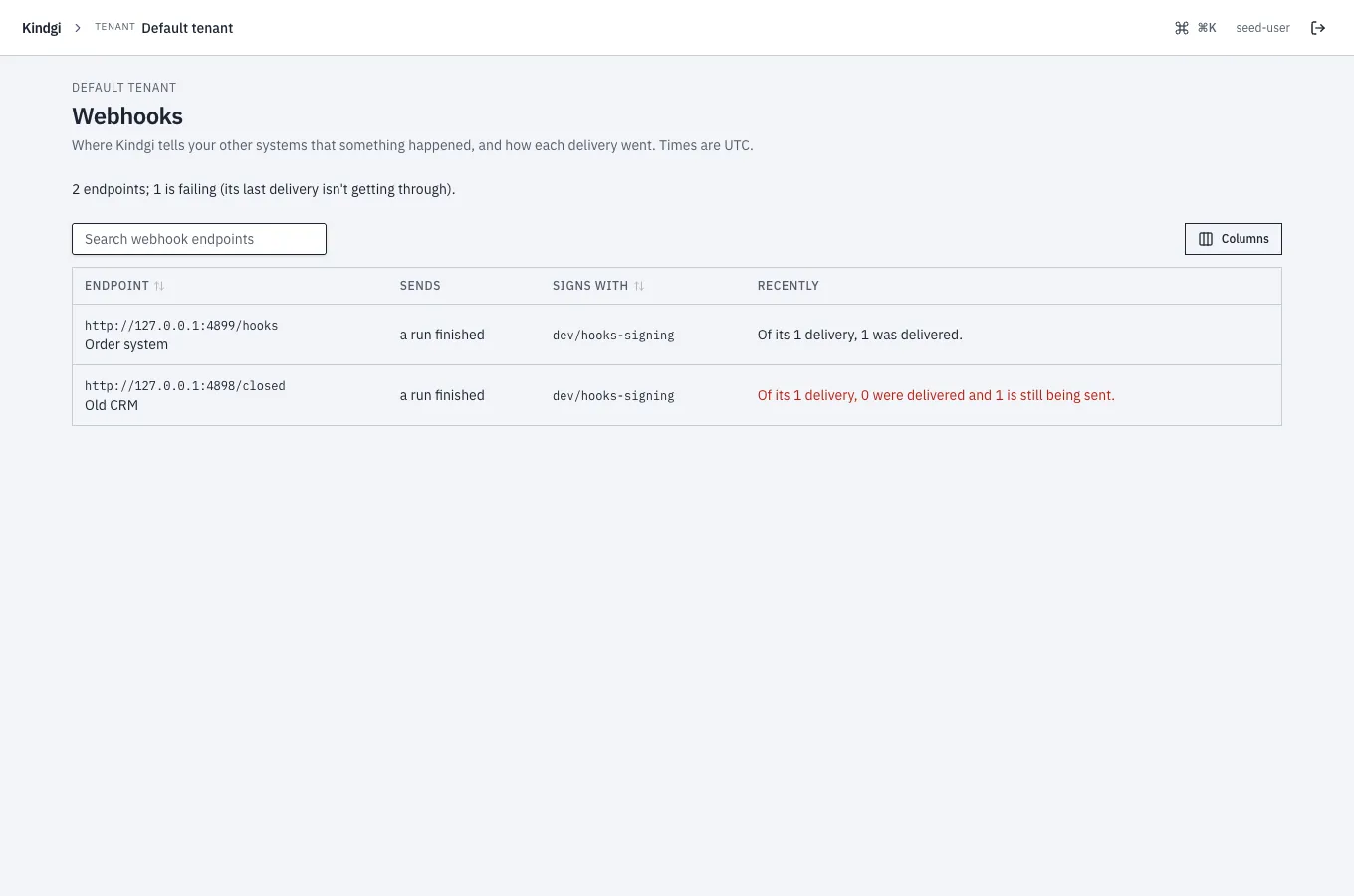
- The headline counts the endpoints and the failing ones: "2 endpoints; 1 is failing (its last delivery isn't getting through)."
- Each endpoint says what it sends ("a run finished"), the secret it signs with, by name only, and how its recent deliveries went: "Of its 1 delivery, 1 was delivered."
An endpoint's page says what it sends and how it signs: "Sends a run finished, signed with the secret dev/hooks-signing (its value stays in the secrets store)." Then each delivery, newest first, as a story:
- "Delivered after 1 attempt";
- "Retrying after 2 attempts (nothing is listening at that address), next attempt …", or the receiver's answer instead, such as "(HTTP 500)";
- "Failed after 6 attempts: HTTP 500", once it has stopped trying;
- for a finished run, the run's outcome and Open the run.
The other reasons it gives are "it didn't answer in time", "its host name doesn't resolve", "its address is one webhooks may not go to", "its TLS certificate wasn't accepted" and "the connection failed". All, Failed, Being sent and Delivered filter the list.
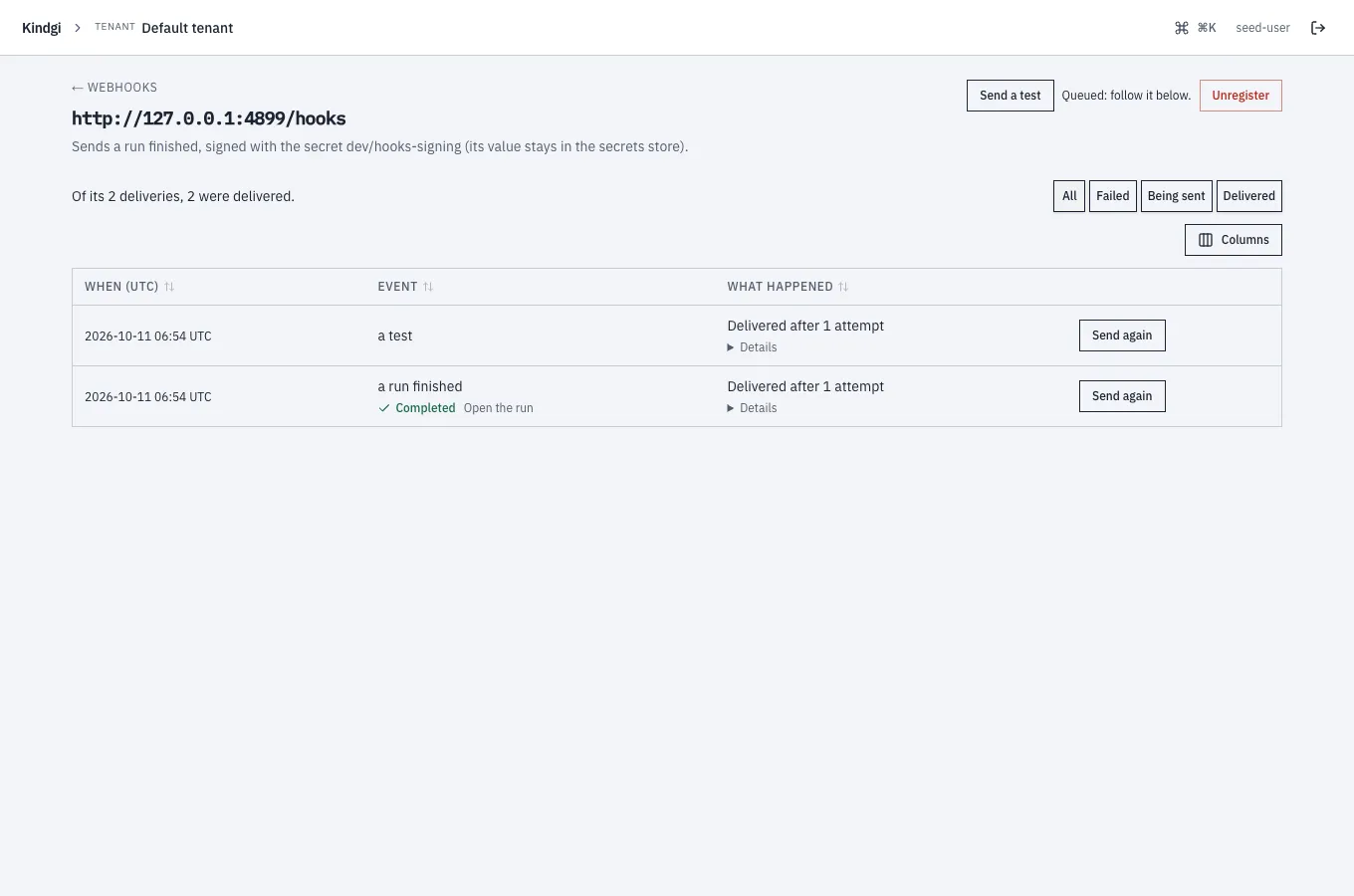
- Send a test queues a test event ("Queued: follow it below."), which shows in the list as "a test".
- Send again queues that delivery once more ("Queued.").
- Unregister: "Nothing more is sent to it. Deliveries still waiting are marked failed." It can't be brought back from the console: add it again. Its old address then says "No endpoint by that id here: it was unregistered, or never existed."
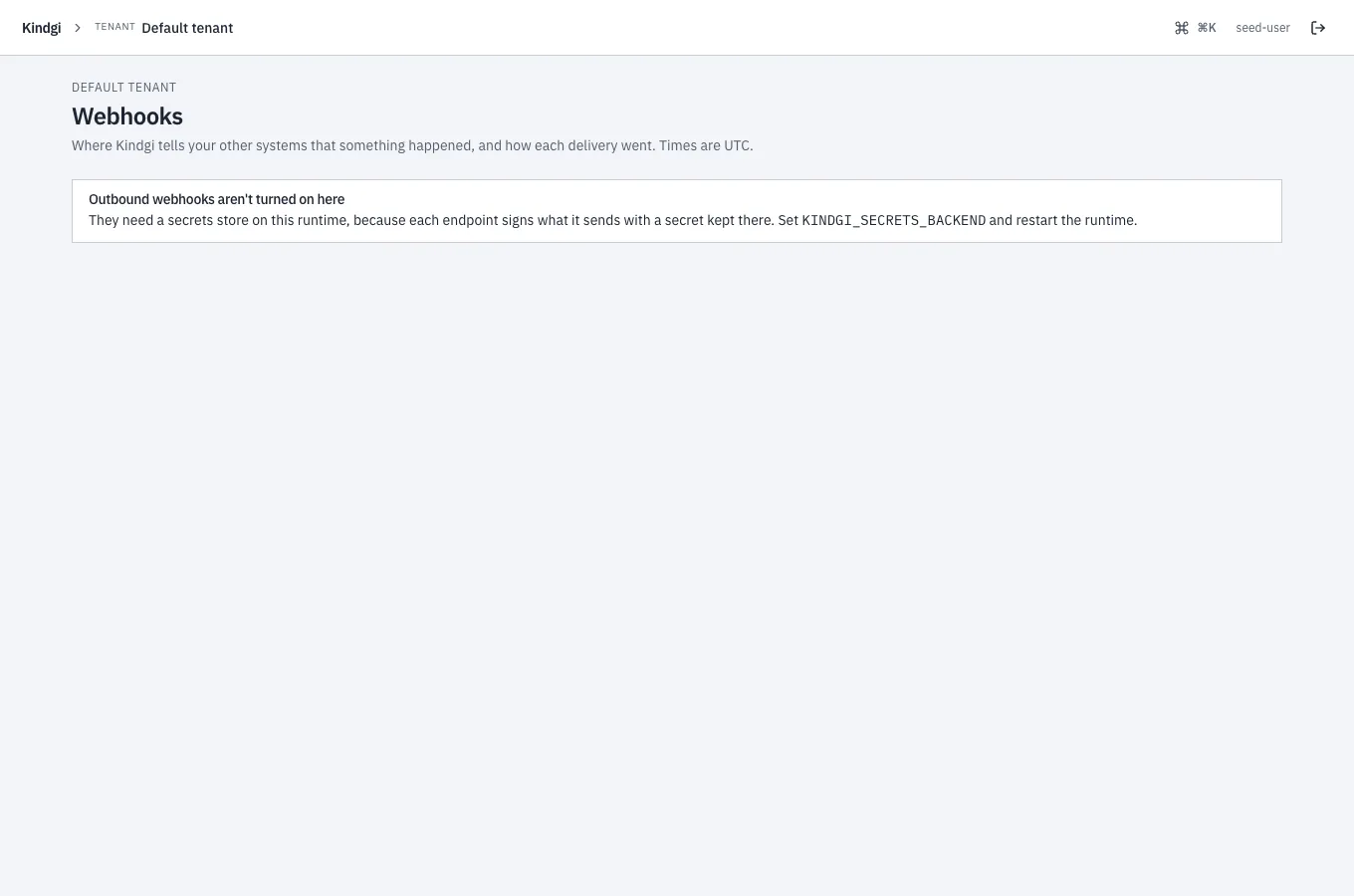
A runtime without a secrets store sends no webhooks, and the page says so:
"Outbound webhooks aren't turned on here". Endpoints sign with a secret kept
in the store, so set KINDGI_SECRETS_BACKEND and restart the runtime.