Cost per run and per customer
Kindgi records every model call a run makes: the model, the tokens, and what the call cost at the prices its provider was registered with (see Connect a model). Read the records of one run or of a flow's whole run, sum them for one customer's month, or get each run's total when it finishes. These costs are Kindgi's estimates from the vendors' published prices; your provider's invoice is what you pay.
A run's calls
Section titled “A run's calls”import { createClient } from '@kindgi/sdk/client';import type { RunId } from '@kindgi/sdk/types';
const kindgi = createClient(); // KINDGI_API_URL, KINDGI_API_TOKEN, or the running kindgi dev
const calls = await kindgi.cost.usage.query({ runId: process.argv[2] as RunId });for (const call of calls.data) { console.log(call.step, call.model, call.status, call.usage?.promptTokens, call.usage?.completionTokens, call.costUsd);}import sys
from kindgi.client import Kindgi
kindgi = Kindgi() # KINDGI_API_URL, KINDGI_API_TOKEN, or the running kindgi dev
calls = kindgi.cost.records.list(run_id=sys.argv[1])for call in calls.data: usage = call.usage print(call.step, call.model, call.status, usage and usage.prompt_tokens, usage and usage.completion_tokens, call.cost_usd)For an agent turn that called a tool once, both print two model calls, the newest first:
2 claude-sonnet-5-5 ok 606 152 0.0027321 claude-sonnet-5-5 ok 513 57 0.0015960000000000002Each record is one model call:
{ "id": "bfe7ccd4-ca6c-411c-918f-e605b4943bdd", "tenantId": "c963c8d8-5afc-403f-8c4b-8617327c424e", "category": "llm.inference", "providerId": "anthropic", "runId": "f3835200-e4c6-4579-a3fc-4b70f7444333", "agentId": "acme.order-desk", "conversationId": "936af311-f1c8-4260-a1ed-973876b4ac71", "quantity": 570, "unit": "tokens", "costUsd": 0.0015960000000000002, "occurredAt": "2026-10-08T15:13:23.128Z", "callId": "00a26a40-58c5-41ce-af41-a5c583a577a6", "projectId": "18af3731-67e6-4720-aa50-0972ff4b5eca", "rootRunId": "f3835200-e4c6-4579-a3fc-4b70f7444333", "agentVersion": "0.1.0", "nodeId": "model-call", "step": 1, "model": "claude-sonnet-5-5", "servedModel": "claude-sonnet-5-5", "status": "ok", "usage": { "promptTokens": 513, "completionTokens": 57, "cacheReadTokens": 0, "cacheWriteTokens": 0 }, "durationMs": 1438, "finishReason": "tool-use", "providerRequestId": "req_011CfpzCE92VRAVmBURYMRFu", "attempts": 1}| Field | What it is |
|---|---|
model, servedModel |
The model the agent asked for, and the exact version the provider answered with. |
usage |
The tokens: promptTokens, completionTokens, and the cache and reasoning counts. A count the provider reports is there, 0 included; one it doesn't report is absent. |
costUsd |
The call's cost in US dollars. |
status |
ok, or failed (see A failed call). |
step |
The model call's number in the turn. |
runId, rootRunId |
The run that made the call, and the run at the top of its tree. |
flowId |
For an agent step in a flow, the flow. An agent run on its own has none. |
projectId, agentId, agentVersion, conversationId |
Where the call belongs. |
providerRequestId |
The provider's id for the request, to quote to its support. Not every provider sends one. |
callId |
The call's id. The model call's node in the turn's provenance has the same callId. |
To see the usage exactly as the provider sent it, add includeRawUsage: true
(Python: include="rawUsage"). Each record then has rawUsage:
"rawUsage": { "provider": "anthropic", "model": "claude-sonnet-5-5", "usage": { "input_tokens": 513, "output_tokens": 57, "cache_read_input_tokens": 0, "cache_creation_input_tokens": 0, … }}A flow's whole run
Section titled “A flow's whole run”Each agent step of a flow runs as a run of its own, under the flow's run. The
flow's run makes no model calls itself, so ask for its whole tree with
rootRunId:
const calls = await kindgi.cost.usage.query({ rootRunId: flowRunId });calls = kindgi.cost.records.list(root_run_id=flow_run_id)Each record's runId is the agent step's run, and its rootRunId is the
flow's run.
One customer's month
Section titled “One customer's month”Give each of your customers an org, and run their work in a project of that org (Organize work by org and project). One call then sums a customer's spend, here by month and model:
import { createClient } from '@kindgi/sdk/client';import type { Timestamp } from '@kindgi/sdk/types';
const kindgi = createClient(); // KINDGI_API_URL, KINDGI_API_TOKEN, or the running kindgi dev
// Once per customer: an org, and a project in it.const org = await kindgi.orgs.create({ slug: 'acme-customer-one', name: 'Customer one' });const project = await kindgi.projects.create({ orgId: org.id, slug: 'support', name: 'Support' });
// Each run for that customer names the project.await kindgi.runs.start({  agent: 'acme-ops.echo-agent',  input: { userMessage: 'Echo hello.' },  projectId: project.id,});
// The customer's month so far, by model.const now = new Date();const monthStart = new Date(Date.UTC(now.getUTCFullYear(), now.getUTCMonth(), 1));const month = await kindgi.cost.usage.summary({ scope: { kind: 'org', orgId: org.id }, from: monthStart.toISOString() as Timestamp, to: now.toISOString() as Timestamp, groupBy: ['month', 'model'],});console.log(JSON.stringify(month, null, 2));import jsonfrom datetime import datetime, timezone
from kindgi.client import Kindgi
kindgi = Kindgi() # KINDGI_API_URL, KINDGI_API_TOKEN, or the running kindgi dev
# Once per customer: an org, and a project in it.org = kindgi.orgs.create(slug="acme-customer-one", name="Customer one")project = kindgi.projects.create(org_id=str(org.id), slug="support", name="Support")
# Each run for that customer names the project.kindgi.runs.start( agent="acme-ops.echo-agent", input={"userMessage": "Echo hello."}, project_id=project.id,)
# The customer's month so far, by model.now = datetime.now(timezone.utc)month = kindgi.cost.aggregate( group_by="month,model", scope_kind="org", scope_id=str(org.id), from_=now.replace(day=1, hour=0, minute=0, second=0, microsecond=0).isoformat(), to=now.isoformat(),)print(json.dumps(month.model_dump(mode="json", by_alias=True, exclude_none=True), indent=2))The sum covers only that customer's runs:
{ "groups": [ { "key": {"month": "2026-10", "model": "claude-sonnet-5-5"}, "count": 2, "totalUsd": 0.00449, "tokens": {"prompt": 1385, "completion": 172, "cacheRead": 0, "cacheWrite": 0, "reasoning": 0} } ], "totalGroups": 1, "truncated": false, "totalUsd": 0.00449, "totalRecords": 2, "tokens": {"prompt": 1385, "completion": 172, "cacheRead": 0, "cacheWrite": 0, "reasoning": 0}, "timeRange": {"from": "2026-10-01T00:00:00.000Z", "to": "2026-10-08T15:13:28.571Z"}, "groupBy": ["month", "model"]}scopenarrows the sum to an org ({ kind: 'org', orgId }) or a project ({ kind: 'project', projectId }). Python:scope_kindandscope_id.- Who sees what: the sum needs
readon its scope. Across projects (no scope, or an org), it counts only the projects the caller may read, and records with no project; a tenant admin's sum counts every project. Where the deployment's cost store can't apply the limit, anyone but a tenant admin is refused (403). fromandto: the time window;tois exclusive.- The groups come most expensive first, at most 1000 of them;
?limit=on the API (Python:limit=), up to 10000, sets another cap.truncatedsays whether some were left out, andtotalGroupshow many there were; the totals always cover every record. To read every record instead, page throughcost.usage.query. groupBysplits the sum. Besidesmonthandmodel:day,orgId,projectId,agentId,flowId,runId,rootRunId,conversationId,providerId,servedModel,categoryandtenant. With nogroupBy, you get the totals only.
A tool can check that a run belongs to the right customer: see Check the run's org.
When a run finishes
Section titled “When a run finishes”The run.finished webhook carries the
run's total under data.run.usage:
{ "id": "8004eba4-0d7a-4b81-9cd2-9c1884295f9c", "type": "run.finished", "createdAt": "2026-10-05T07:08:42.227Z", "data": { "run": { "id": "695492e1-0569-48cf-bf5b-e92170ebcd38", "projectId": "cb742f19-68f2-4594-9cd6-b555617dc851", "flowId": "acme-ops.echo-flow", "flowVersion": "0.1.0", "status": "completed", "dryRun": false, "failureMessage": null, "createdAt": "2026-10-05T07:08:39.834Z", "completedAt": "2026-10-05T07:08:42.227Z", "usage": { "calls": 2, "costUsd": 0.001994, "tokens": { "prompt": 1669, "completion": 65, "cacheRead": 0, "cacheWrite": 0, "reasoning": 0 } } } }}Only the run at the top of a tree sends run.finished, and its usage covers
the whole tree: this flow's two calls were made by its agent step.
A failed call
Section titled “A failed call”A model call that fails is recorded too, at no cost. A turn whose provider key was wrong:
{ "runId": "28a40635-eb0b-44db-9b8f-3748c2f8165e", "model": "claude-sonnet-5-5", "status": "failed", "costUsd": 0, "durationMs": 252, "attempts": 1, "error": { "message": "401 {\"type\":\"error\",\"error\":{\"type\":\"authentication_error\",\"message\":\"invalid x-api-key\"},\"request_id\":null}" }, …}It has no usage, and it counts in run.finished's calls.
Cost in the console
Section titled “Cost in the console”The console shows the same numbers on three pages: a project's Cost, a run's Cost tab, and the tenant's Tenant costs. Days are in UTC, and a failed call costs $0.
A project's cost
Section titled “A project's cost”Anyone who can read the project sees its Cost page: what its model calls cost over a range (7 days, 30 days, 90 days, 12 months or Custom), against the range before.
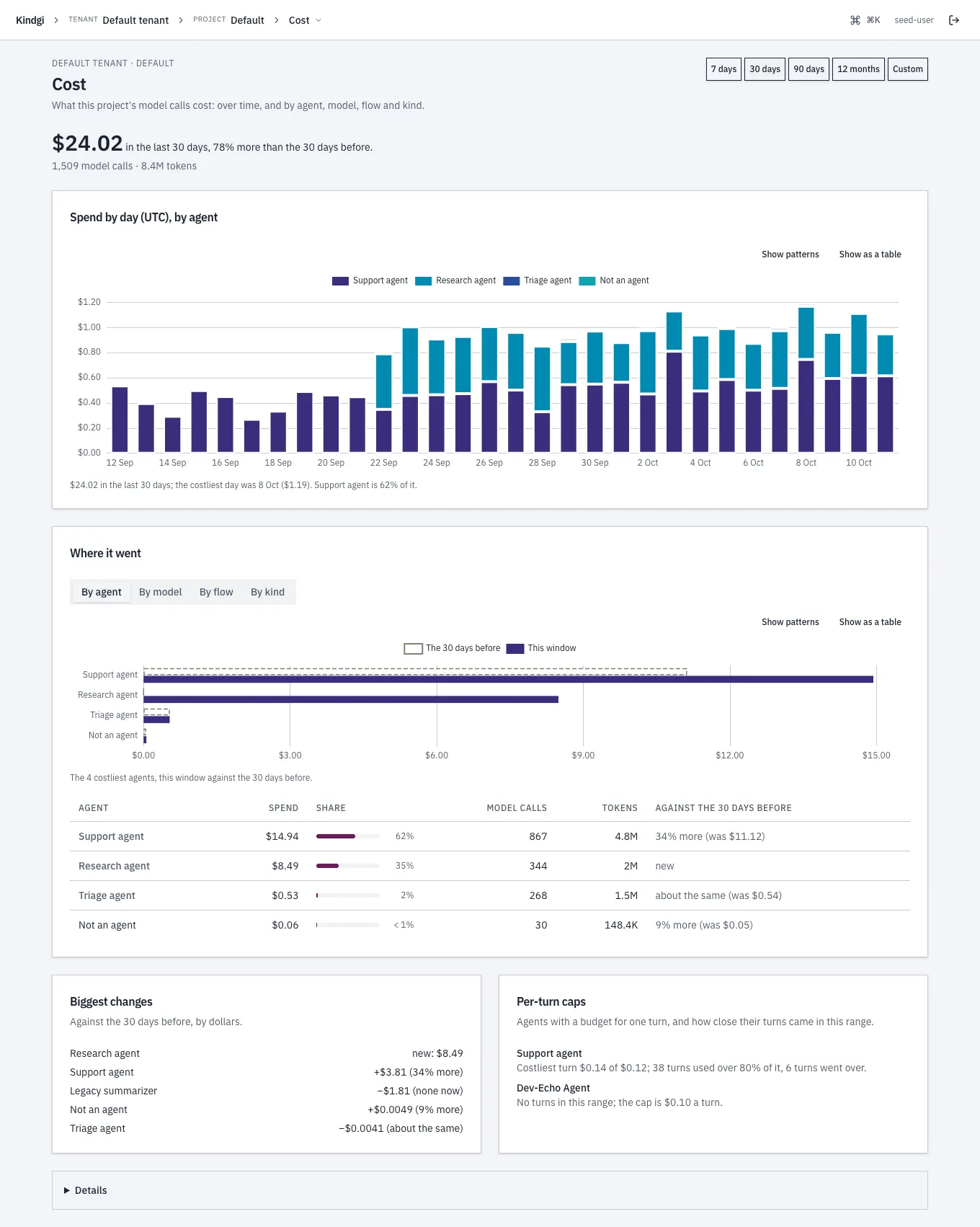
- The headline: "$24.02 in the last 30 days, 78% more than the 30 days before." and "1,509 model calls · 8.4M tokens".
- Spend by day (UTC), by agent: a stacked chart, with a sentence under it ("the costliest day was 8 Oct ($1.19). Support agent is 62% of it."). Show as a table gives the numbers. Over 12 months it's by month.
- Where it went: By agent, By model, By flow or By kind, the costliest against the range before ("34% more (was $11.12)", "new"). An agent's or a model's row filters the page to it.
- Biggest changes: against the range before, by dollars ("Research agent new: $8.49", "Legacy summarizer −$1.81 (none now)").
- Per-turn caps: each agent with a budget for one turn, and how close its turns came ("Costliest turn $0.14 of $0.12; 38 turns used over 80% of it, 6 turns went over.").
- Details: the token split, and the exact
GET /v1/cost/aggregatequeries the page made.
The range and the breakdown are in the page's address, so a link opens the same view.
A run's cost
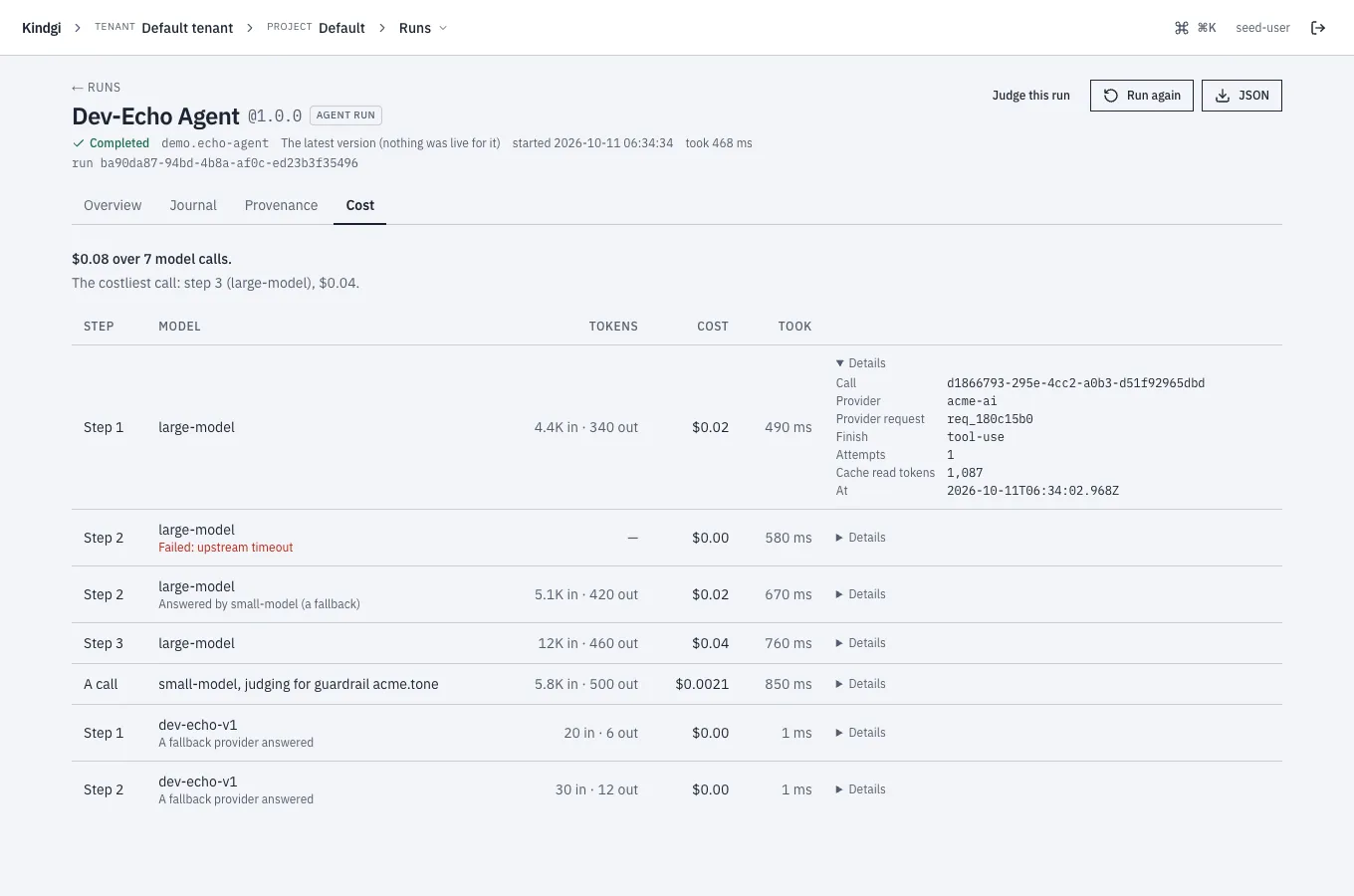
Section titled “A run's cost”Every run's page has a Cost tab: the run's calls, as
cost.usage.query returns them.
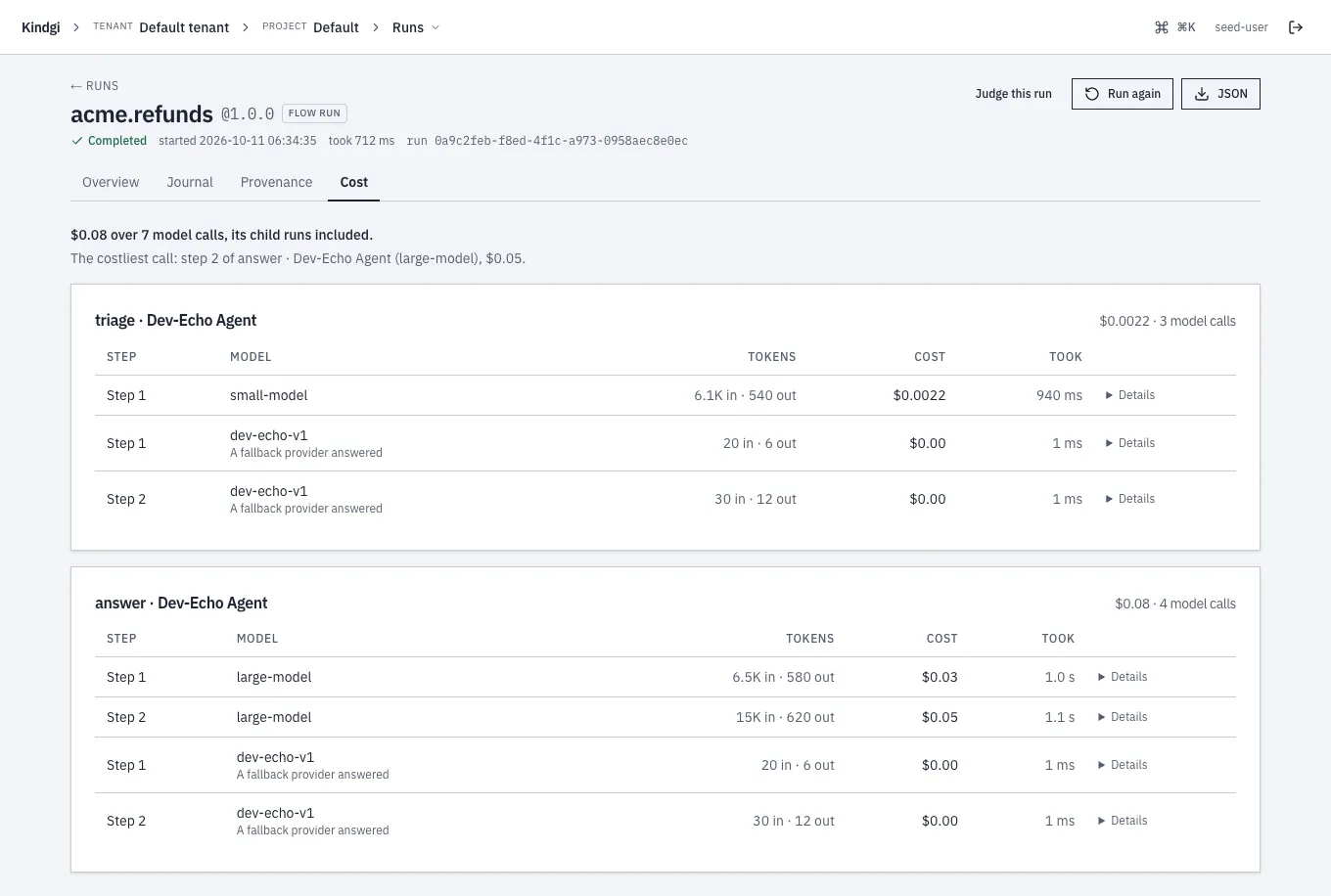
- The total, with a flow's child runs included: "$0.08 over 7 model calls, its child runs included."
- The costliest call: "The costliest call: step 2 of answer · Dev-Echo Agent (large-model), $0.05."
- Each model call, grouped by the run that made it: its step, model, tokens in and out, cost and how long it took. A failed call says why ("Failed: upstream timeout") and costs $0.00. When a fallback answered, the call says so ("A fallback provider answered").
- Details, for one call: the call's id, the provider and its request id, how it finished, its attempts, cache-read tokens and when it was made.
A flow run's Overview tab gives the same total: "Cost: $0.08 over 7 model calls, its child runs included. Each call →".
The tenant's costs
Section titled “The tenant's costs”Tenant admins see Tenant costs: every project's spend, laid out like a project's Cost page.
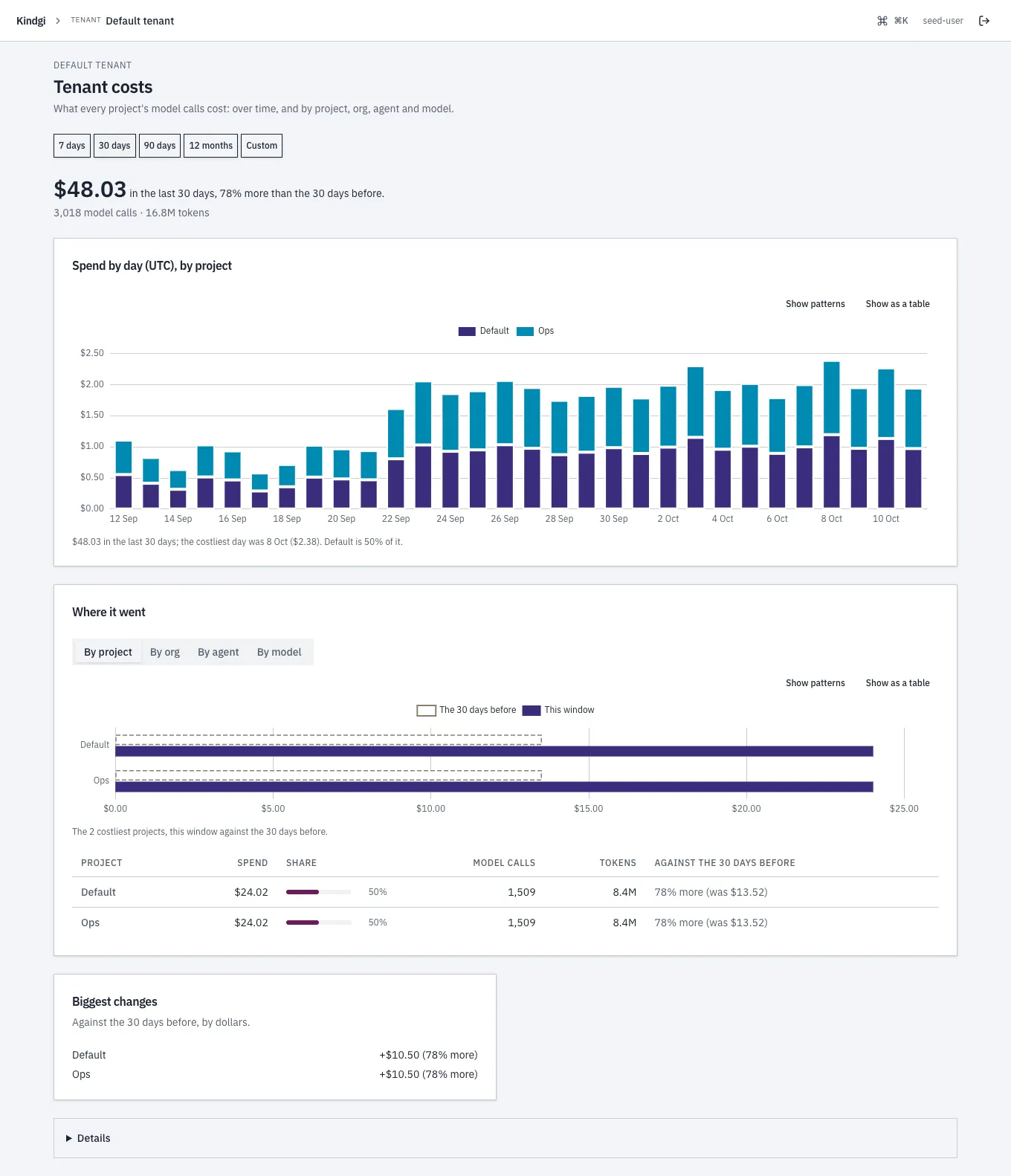
- The headline, and Spend by day (UTC), by project.
- Where it went: By project, By org, By agent or By model. A project's row opens that project's Cost page at the same range, and an agent's or a model's row filters this page.
- Biggest changes and Details, as on a project's page.
Anyone else who opens it is pointed to each project's Cost page instead. As with the API (see One customer's month), a person's numbers count only the projects they may read.