Write a flow
This page builds acme.process-order: look an order up, have an agent write
a thank-you note, then confirm the order with that note. Two tools, one
agent, one flow.
The tools
Section titled “The tools”acme.get-order only reads, so it says mutating: false.
acme.confirm-order changes something, so it doesn't:
import { defineTool } from '@kindgi/sdk/define';import type { ToolId } from '@kindgi/sdk/types';import { z } from 'zod';
const Order = z.object({  orderId: z.string(),  customer: z.string(),  total: z.number(),  items: z.array(z.object({ sku: z.string(), quantity: z.number().int() })),});
const ORDERS: Record<string, z.infer<typeof Order>> = {  'A-100': { orderId: 'A-100', customer: 'ada@example.com', total: 42.5, items: [{ sku: 'mug', quantity: 2 }] },  'A-200': {    orderId: 'A-200',    customer: 'grace@example.com',    total: 1250,    items: [      { sku: 'desk', quantity: 1 },      { sku: 'lamp', quantity: 2 },    ],  },};
const defined = defineTool({  id: 'acme.get-order' as ToolId,  description: 'Looks up an order by id.',  version: '0.1.0',  input: z.object({ orderId: z.string().min(1) }),  output: Order,  effects: [],  mutating: false, // only reads  handler: async ({ orderId }) => {    const order = ORDERS[orderId];    if (order === undefined) throw new Error(`No order ${orderId}`);    return order;  },});
if (defined.kind === 'err') throw new Error(defined.error.message);
export default defined.value;import { defineTool } from '@kindgi/sdk/define';import type { ToolId } from '@kindgi/sdk/types';import { z } from 'zod';
const defined = defineTool({ id: 'acme.confirm-order' as ToolId, description: 'Confirms an order and emails the customer.', version: '0.1.0', input: z.object({ orderId: z.string(), note: z.string().optional() }), output: z.object({ orderId: z.string(), status: z.literal('confirmed'), note: z.string().optional(), }), effects: [], // no `mutating: false`: it changes something handler: async ({ orderId, note }) => ({ orderId, status: 'confirmed' as const, note }),});
if (defined.kind === 'err') throw new Error(defined.error.message);
export default defined.value;from pydantic import BaseModel, Field
from kindgi import tool
class OrderQuery(BaseModel): order_id: str = Field(alias="orderId", min_length=1)
class Item(BaseModel): sku: str quantity: int
class Order(BaseModel): order_id: str = Field(alias="orderId") customer: str total: float items: list[Item]
ORDERS = { "A-100": {"customer": "ada@example.com", "total": 42.5, "items": [{"sku": "mug", "quantity": 2}]}, "A-200": { "customer": "grace@example.com", "total": 1250, "items": [{"sku": "desk", "quantity": 1}, {"sku": "lamp", "quantity": 2}], },}
@tool(id="acme.get-order", mutating=False) # only readsdef get_order(input: OrderQuery) -> Order: """Looks up an order by id.""" order = ORDERS.get(input.order_id) if order is None: raise ValueError(f"No order {input.order_id}") return Order(orderId=input.order_id, **order)from typing import Literal
from pydantic import BaseModel, Field
from kindgi import tool
class ConfirmInput(BaseModel): order_id: str = Field(alias="orderId") note: str | None = None
class Confirmed(BaseModel): order_id: str = Field(alias="orderId") status: Literal["confirmed"] = "confirmed" note: str | None = None
@tool(id="acme.confirm-order") # no mutating=False: it changes somethingdef confirm_order(input: ConfirmInput) -> Confirmed: """Confirms an order and emails the customer.""" return Confirmed(orderId=input.order_id, note=input.note)The agent
Section titled “The agent”The agent has no tools: it reads the order's customer and total from its input and answers with one sentence.
import { defineAgent } from '@kindgi/sdk/define';import type { AgentId, Semver } from '@kindgi/sdk/types';
const defined = defineAgent({  id: 'acme.note-writer' as AgentId,  version: '0.1.0' as Semver,  name: 'Note writer',  description: 'Writes a one-sentence thank-you note for an order.',  instructions:    'Write a one-sentence thank-you note to {{ input.customer }} for their order of {{ input.total }} USD. Answer with the note only.',  capabilities: [{ needs: [{ feature: 'tool-use' as const }] }],  tools: [],  retrieval: [],  guardrails: [],  parameters: [],  budget: { maxSteps: 2, maxCostUsd: 0.05, maxWallMs: 30_000 },});
if (defined.kind === 'err') throw new Error(defined.error.message);
export default defined.value;from kindgi import Agent
note_writer = Agent( id="acme.note-writer", version="0.1.0", name="Note writer", description="Writes a one-sentence thank-you note for an order.", instructions=( "Write a one-sentence thank-you note to {{ input.customer }} for their order of " "{{ input.total }} USD. Answer with the note only." ), capabilities=[{"needs": [{"feature": "tool-use"}]}], budget={"maxSteps": 2, "maxCostUsd": 0.05, "maxWallMs": 30_000},)The flow
Section titled “The flow”import { defineFlow } from '@kindgi/sdk/define';
const defined = defineFlow({ id: 'acme.process-order', version: '0.1.0', name: 'Process an order', description: 'Looks up an order, writes a thank-you note, and confirms the order with it.', nodes: [ { id: 'order', kind: 'tool', ref: 'acme.get-order', inputMapping: { orderId: { path: 'runInput.orderId' } }, }, { id: 'note', kind: 'agent', ref: 'acme.note-writer', inputMapping: { customer: { path: 'nodeOutputs.order.customer' }, total: { path: 'nodeOutputs.order.total' }, }, }, { id: 'confirm', kind: 'tool', ref: 'acme.confirm-order', inputMapping: { orderId: { path: 'runInput.orderId' }, note: { path: 'nodeOutputs.note.text' }, }, }, ], edges: [ { id: 'e1', from: '$start', to: 'order' }, { id: 'e2', from: 'order', to: 'note' }, { id: 'e3', from: 'note', to: 'confirm' }, { id: 'e4', from: 'confirm', to: '$end' }, ],});
if (defined.kind === 'err') throw new Error(defined.error.message);
export default defined.value;from kindgi import Flow
process_order = Flow( id="acme.process-order", version="0.1.0", name="Process an order", description="Looks up an order, writes a thank-you note, and confirms the order with it.", nodes=[ { "id": "order", "kind": "tool", "ref": "acme.get-order", "inputMapping": {"orderId": {"path": "runInput.orderId"}}, }, { "id": "note", "kind": "agent", "ref": "acme.note-writer", "inputMapping": { "customer": {"path": "nodeOutputs.order.customer"}, "total": {"path": "nodeOutputs.order.total"}, }, }, { "id": "confirm", "kind": "tool", "ref": "acme.confirm-order", "inputMapping": { "orderId": {"path": "runInput.orderId"}, "note": {"path": "nodeOutputs.note.text"}, }, }, ], edges=[ {"id": "e1", "from": "$start", "to": "order"}, {"id": "e2", "from": "order", "to": "note"}, {"id": "e3", "from": "note", "to": "confirm"}, {"id": "e4", "from": "confirm", "to": "$end"}, ],)nodesare the steps. Each has anid(unique in the flow), akindand aref: the id of the tool or agent it runs. In Python,refcan also be theToolorAgentobject you import.edgesconnect them.$startand$endare where the run enters and leaves; an edge without a condition fires when its source step completes.inputMappingbuilds each step's input from the run's input (runInput.…) and earlier steps' outputs (nodeOutputs.<step>.…). See Pass data between steps.
The shape is checked when the file loads: ids, edges between steps that
exist, $start and $end, no cycles. That the tools and the agent exist is
checked when a run starts: a run of a flow that names a tool your tenant
doesn't have is refused before anything runs.
Run it
Section titled “Run it”With kindgi dev running in the pack, start a run from a second terminal:
kindgi runs start --flow=acme.process-order --input='{"orderId":"A-100"}'{ "id": "f35d0699-00d8-4e85-944c-e0c9da3ce8e5", … "flowId": "acme.process-order", "flowVersion": "0.1.0", "status": "completed", "dryRun": false, … "output": { "note": "Thank you for your order of $42.50, ada@example.com!", "status": "confirmed", "orderId": "A-100" }, …}The command waits for the run to finish. The flow declares no output, so
the run returns the output of the step that reached $end: here,
acme.confirm-order's.
The agent step
Section titled “The agent step”An agent step runs one turn of the agent, as a run of its own (a child of the
flow's run). The agent gets the step's input twice: as structured input, which
{{ input.customer }} in its instructions reads, and as its user message (the
input as JSON). Give an agent its input
has the details.
The step's output has the answer as text, and as output when the agent
declares a typed answer, plus the turn's runId. Without a model provider,
dev-echo answers, and the note is the agent's input echoed back.
Change it
Section titled “Change it”Save a file and kindgi dev loads the new version; the next run uses it, with
no restart. A run already in flight keeps the version it started on. Change
version when what callers send or get back changes, not on every save.
In the console
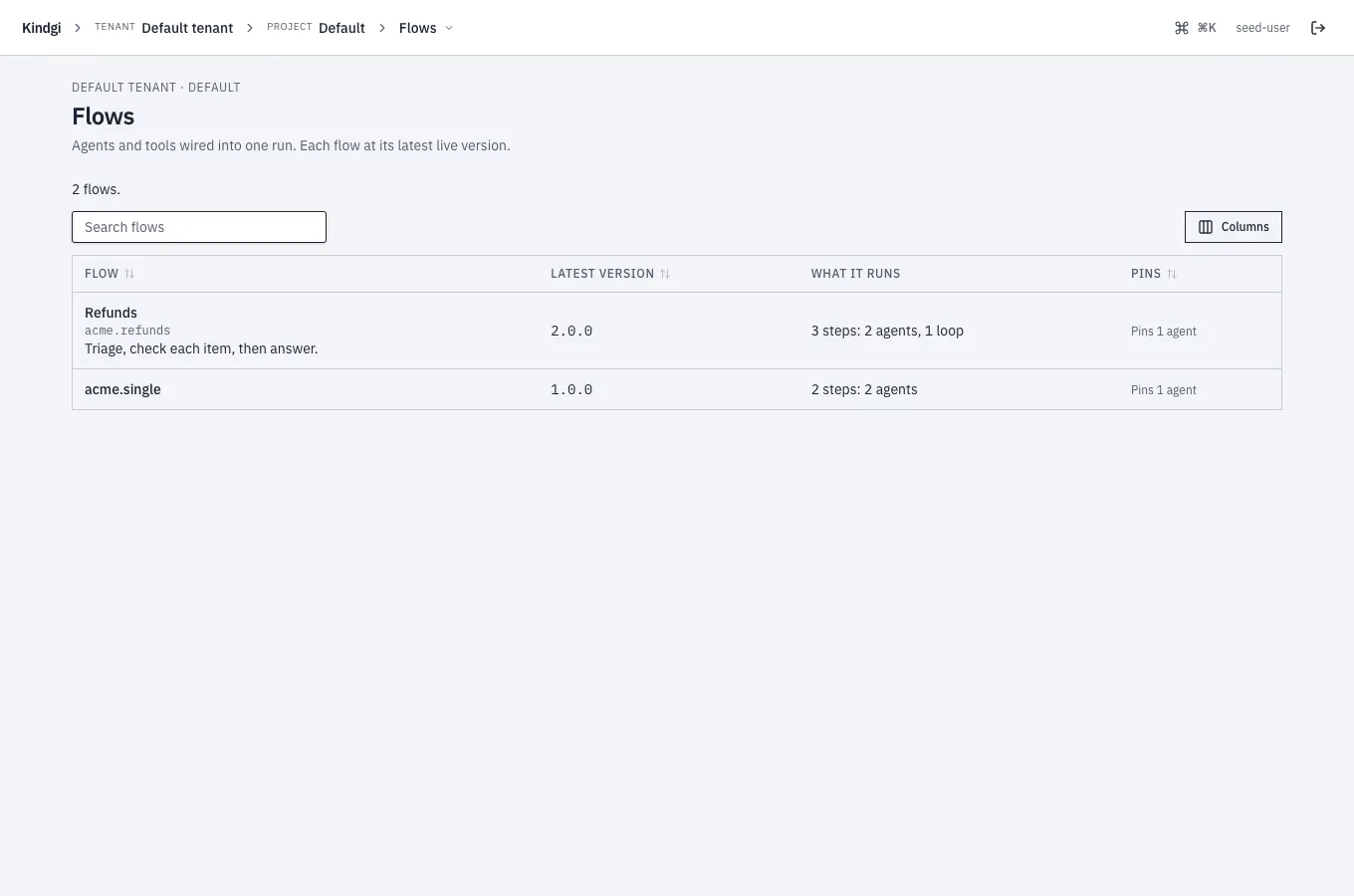
Section titled “In the console”A project's Flows page lists its flows, each at its latest live version: "2 flows.", and for each its name, its latest version, its steps in words ("3 steps: 2 agents, 1 loop") and what it pins ("Pins 1 agent").
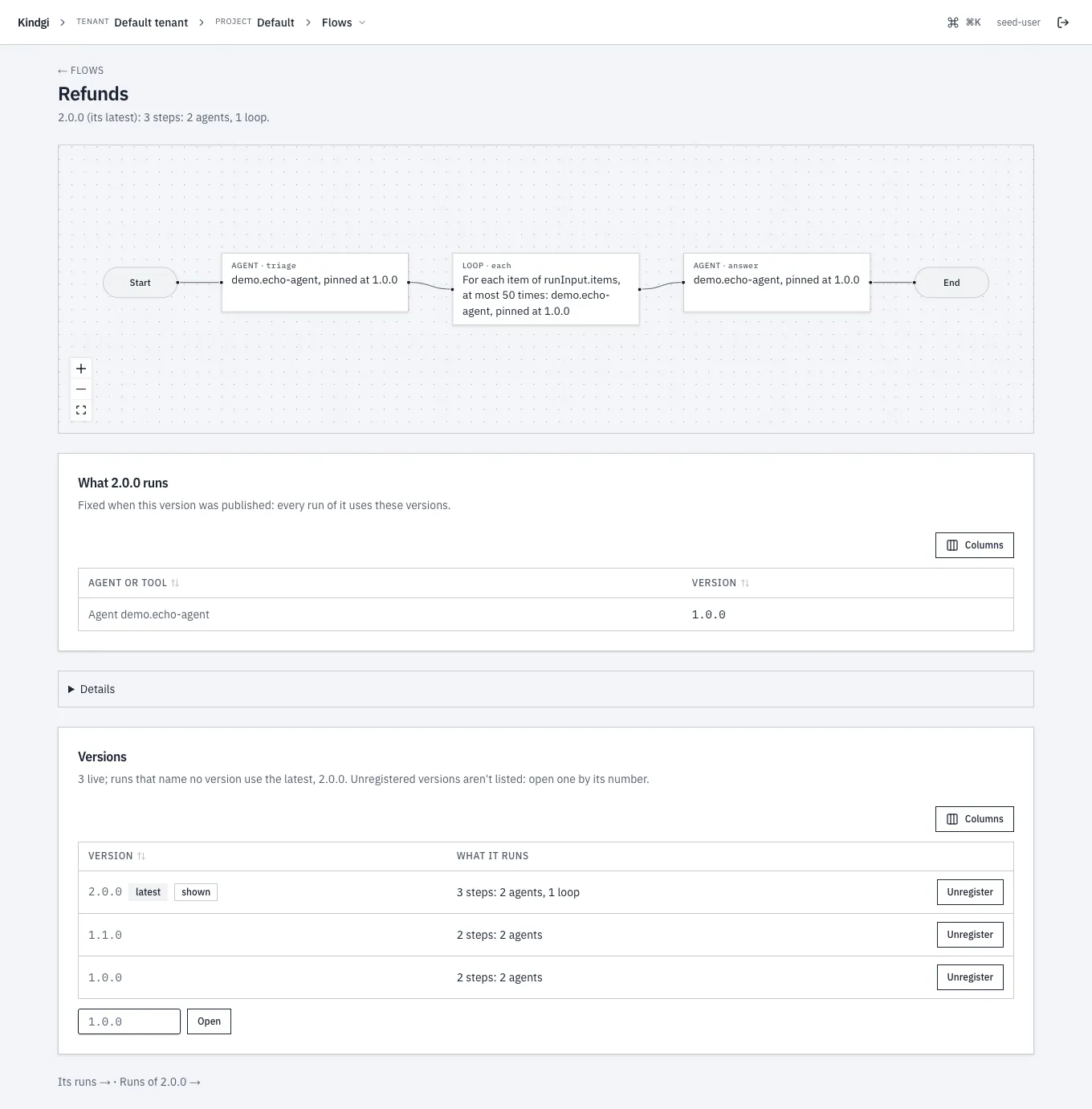
A flow's page draws the version as a graph, from Start to End: each step with what it runs and at which version ("demo.echo-agent, pinned at 1.0.0"), and a loop in words ("For each item of runInput.items, at most 50 times: demo.echo-agent, pinned at 1.0.0"). Below it:
- What 2.0.0 runs: the agents and tools at the versions "Fixed when this version was published: every run of it uses these versions."
- Versions: the live ones, the latest marked, with what each runs: "3 live; runs that name no version use the latest, 2.0.0. Unregistered versions aren't listed: open one by its number."
- Its runs → and Runs of 2.0.0 →, the runs list filtered.
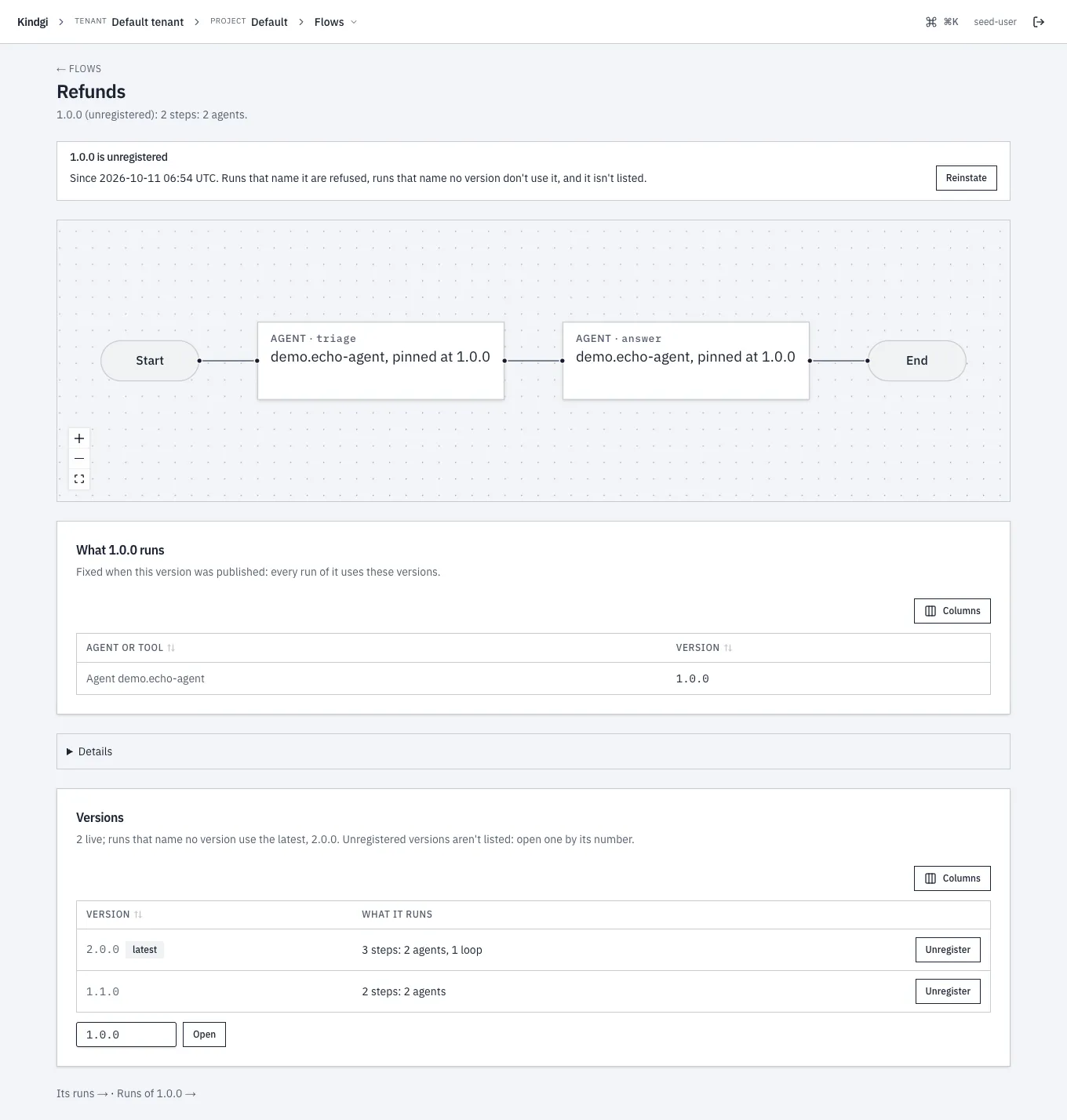
For flow admins, each version has Unregister. Its dialog says what changes:
Unregister 1.0.0?Runs that name no version keep using 2.0.0.Runs that name 1.0.0 are refused, a schedule's included; runs already going finish. It's no longer listed here; it can be reinstated from its own page.While the dialog is still open, Reinstate it undoes it. Later, the version opened by its number says "1.0.0 is unregistered", since when, and "Runs that name it are refused, runs that name no version don't use it, and it isn't listed.", with Reinstate.
Unregistering a flow's only live version takes it off the list, and its page says "No version of this flow is live": "Every version is unregistered, so it isn't listed and runs that name no version are refused. Open a version by its number to reinstate it, or publish a new one."