Decide an approval
A run that waits for a person (a gated tool call or a long conversation) creates an approval. A reviewer decides it, and the run moves on.
Reviewers and roles
Section titled “Reviewers and roles”Only reviewers see approvals. Under kindgi dev you're one already: when it
starts on a database where you aren't a reviewer yet, it registers you, the
user of its token, as an admin:
kindgi reviewers list{ "data": [ { "id": "6c11cfb1-d0c2-46dd-a3a0-e859a57b5da0", "tenantId": "9126df1e-094b-496d-9ea8-7daab93c3f4f", "userId": "26fc414a-b49f-4e1f-a022-162865770178", "role": "admin", "createdAt": "2026-10-05T20:10:59.747Z" } ], "hasMore": false}On any other runtime, register each person who reviews, the user their API token belongs to, with a role. That covers any token of theirs: an API key or a console sign-in.
kindgi reviewers register --spec='{"role":"standard","displayName":"Ada Lovelace"}'{ "id": "b4bc07d5-1640-4c4c-9cbe-710aa6ca7d36", "tenantId": "3a9fb26d-9782-4bdb-a4f9-3c97d2644b72", "userId": "b9b6a8af-84ee-4514-a609-a76230750869", "role": "standard", "displayName": "Ada Lovelace", "createdAt": "2026-10-03T19:55:32.200Z"}The roles rank standard, senior, admin. Each approval has a
requiredRole, and a reviewer sees and decides the approvals that need their
role or a lower one. An approval that needs a higher role doesn't show up in
the list, and fetching or deciding it answers not-found.
Registering again changes the role. kindgi reviewers list shows the
reviewers; kindgi reviewers unregister <reviewer-id> removes one (their
past decisions stay). The list names people, so with authorization on only
a tenant admin or a reviewer reads it; anyone else, a project's viewer say,
gets permission-denied. A user who isn't a reviewer is refused:
Error [auth]: The caller isn't a reviewer: its token carries no reviewer role, and its user isn't registered as one (`kindgi reviewers register`). The approvals surface is reviewer-only.kindgi dev leaves a role you set as it is, and doesn't register you again
after you unregister yourself.
In the console
Section titled “In the console”A project's Approvals page leads to Reviewers: the tenant's roster, with each reviewer's role, when they were added, and whether they're active. Like the list, it's shown to tenant admins and reviewers only; anyone else reads "Who reviews approvals is shown to tenant admins and reviewers."
A tenant admin adds a reviewer with Add a reviewer: find the person among the tenant's people by name or email, choose the role ("They decide approvals of this role and below."), and confirm with the button, which names them, such as Make Eddie Park a standard reviewer. Someone on the roster already isn't added again: "Eddie Park is already on the roster." Remove takes a reviewer off the roster at once; their past decisions stay.
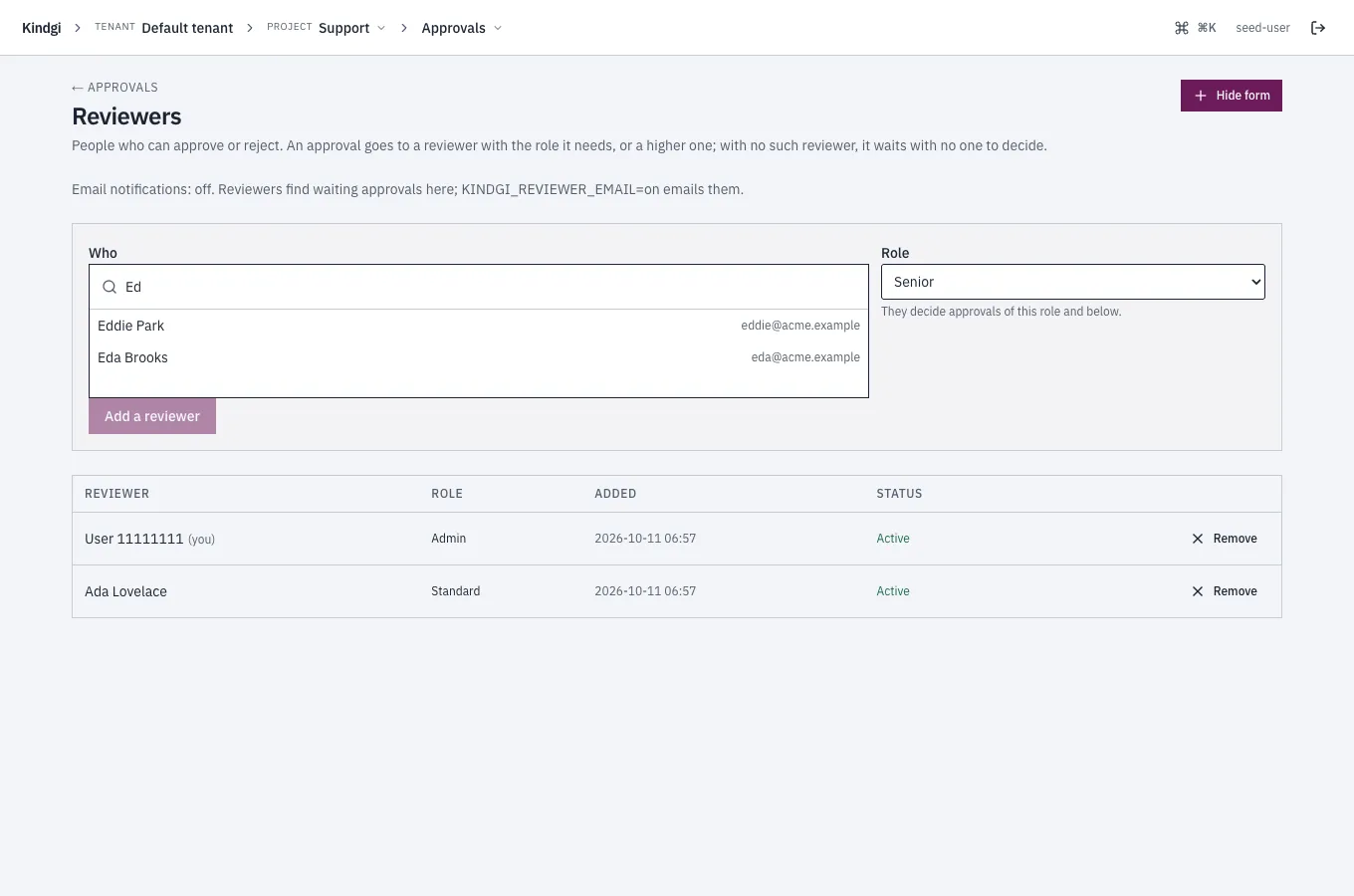
The page also says whether reviewers are emailed (see Reviewer email): "Email notifications: off. Reviewers find waiting approvals here; KINDGI_REVIEWER_EMAIL=on emails them.", or, when it's on, that the first email goes at once, then a digest every five minutes at most.
Reviewer email
Section titled “Reviewer email”With KINDGI_REVIEWER_EMAIL=on, the runtime emails reviewers when an
approval starts waiting, and when a waiting approval is assigned:
- Who: the people the approvals list would show it to: its assigned reviewer, or else every active reviewer of its required role or above. Only those who may read its project.
- Assigned later: a reviewer an approval is assigned to after it started waiting is emailed then, unless they were already emailed about it.
- What: its title, project, required role and when it was asked, and a link to it in the console. Never what it's about: that stays behind sign-in.
- How often: a reviewer's first email goes at once. Anything more for them within five minutes comes as one digest at the end of the five minutes. An approval decided in the meantime is left out.
One approval, as a reviewer gets it (ids elided):
Subject: Approval needed: Refund over the limit
An approval is waiting for you.
Refund over the limit  Project: Default  Needs: a standard reviewer or above  Asked: 2026-10-10 01:37 UTC  …/console/approvals/…
Sign in to decide: what each approval is about is only in the console.
You're getting this because you're a reviewer in Kindgi.
Several in one digest have the subject "2 approvals are waiting for you", with the same lines for each.
It uses the emailed sign-in link's server (KINDGI_AUTH_EMAIL_SMTP_URL and
KINDGI_AUTH_EMAIL_FROM). Turned on without them, the runtime refuses to
start. It's off by default. For a system of your own, an
approval.requested webhook
carries the same facts.
Find what's waiting
Section titled “Find what's waiting”kindgi approvals list --status=pendingkindgi approvals get <approval-id>Without --status, the list includes decided approvals too. To see the
approvals assigned to you, oldest first:
kindgi approvals list --status=assigned,in_review --assigned-to=me --order=ascApprovals nobody is assigned to yet are pending, for any reviewer of their
role:
kindgi approvals list --status=pending --order=asc--status takes several statuses, comma-separated. --assigned-to=me keeps
the approvals assigned to you (assigning one moves it to assigned), and
--order=asc lists the oldest first. In the API these are
GET /v1/approvals?status=assigned,in_review&assignedTo=me&order=asc and
GET /v1/approvals?status=pending&order=asc, and the page says which order
it's in (order). These need the runtime 0.1.6 or later: an earlier one takes
one status and lists newest first.
In each approval:
subjectKindis what waits:tool-call:pendingis a tool call (thesubjectRefhas thetoolIdand thearguments);agent-turn:session-hitl-gateis a conversation that reached its turn limit (thesubjectRefhas theconversationIdand theturnCount).requiredRoleis the lowest role that may decide it.provenanceRef.runIdis the run that waits.decision, once someone decided it: the decision, the rationale, who (decidedBy, asuser:<id>, and theirreviewerId), their role then, and when. There's none while it's open, nor when it ended without a decision (it expired, or a timeout escalated it).
"decision": { "decision": "approve", "decidedBy": "user:26fc414a-b49f-4e1f-a022-162865770178", "reviewerId": "974b5bb3-c690-4886-a609-c7fe0cbd5659", "reviewerRoleAtDecision": "standard", "decidedAt": "2026-10-05T16:25:52.878Z", "rationale": "Confirmed with the on-call engineer"}What a run waits for
Section titled “What a run waits for”From a run, kindgi runs resume <run-id> says what it waits for, and how
it goes on:
kindgi runs resume 45d986f1-8a8d-4341-a786-5ddcf239bb93Run 45d986f1-8a8d-4341-a786-5ddcf239bb93 waits for approval b3fcf729-0137-430e-92a3-2ff10f4a6bde ("HITL review required for Chat desk"), for a standard reviewer or above. It continues once the approval is decided: kindgi approvals complete b3fcf729-0137-430e-92a3-2ff10f4a6bde --decision=approve (or --decision=reject).That sentence goes to stderr. Its standard output is the same answer as JSON, for a script:
{ "kind": "approval", "runId": "45d986f1-8a8d-4341-a786-5ddcf239bb93", "status": "suspended", "approvals": [ { "id": "b3fcf729-0137-430e-92a3-2ff10f4a6bde", "title": "HITL review required for Chat desk", "requiredRole": "standard", "status": "pending" } ], "alsoWaitsOn": []}Its exit code says which:
| Exit | The run |
|---|---|
0 |
isn't waiting: Run … is completed: it isn't waiting, so there's nothing to resume. |
3 |
waits for an approval, named as above |
4 |
waits on the runtime: a queued start, a child run, a retry, a lease |
Once the approval is decided, the run goes on by itself.
From your app, kindgi.runs.get(runId) answers the same for a suspended run,
as waitingFor (runtime 0.1.6 and later): approvals, the ones still to be
decided, and other, the rest (a child run to finish, an approval already
decided, a wait no approval is linked to). The CLI's answer is runs resume;
the API's is waitingFor:
{ "id": "45d986f1-8a8d-4341-a786-5ddcf239bb93", … "status": "suspended", … "waitingFor": { "approvals": [ { "approvalId": "b3fcf729-0137-430e-92a3-2ff10f4a6bde", "status": "pending", "requiredRole": "standard", "title": "HITL review required for Chat desk", "createdAt": "2026-10-11T07:55:48.728Z", "expiresAt": "2026-10-12T07:55:48.703Z", "subjectKind": "agent-turn:session-hitl-gate" } ], "other": [] }}kindgi.approvals.list({ waitTokenIds: [...] }) (wait_token_id=[...] in
Python, ?waitTokenId= over HTTP) lists the approvals behind given waits.
In the console: your Inbox
Section titled “In the console: your Inbox”A reviewer's Inbox lists every open approval they may decide, across the projects they can read, the one that has waited longest first. Its headline says how many and for how long, such as "4 approvals wait for you: the oldest for 3 h. 1 is assigned to you.", or "Nothing waits for you."
- Filters by project, tier, Assigned to you or No one assigned, kept in the page's link.
- Who it's assigned to reads "You", "A reviewer" or "No one", never a name.
- Choose one to see it beside the list (in the list's place on a narrow screen) and decide it there. After a decision, the next one is chosen.
- Approve or reject several in one go (see Several in one go), and move through the list by keyboard (see By keyboard).
- It reads again every 15 seconds and when you come back to the tab. One that left without your decision says so: "No longer waiting: … (decided by someone else, withdrawn or expired)."
- One you asked for reads "You asked: someone else approves it".
- Past 500 open approvals, it holds those that have waited longest, and still lists every one assigned to you. The headline then says "More may wait than the inbox could read: it holds those that have waited longest. Each project's Approvals page lists them all."
An approval's own link, /console/approvals/<approval-id>, finds its
project by itself: one still waiting opens in your Inbox, chosen; a decided
one opens its own page. The link in a reviewer email is
that link.
Decide
Section titled “Decide”kindgi approvals complete <approval-id> --decision=approve --rationale="Confirmed with the on-call engineer"--rationale is optional and is kept with the decision. The four decisions:
| Decision | The approval | The run |
|---|---|---|
approve |
approved |
Continues: the tool runs, or the turn runs. |
reject |
rejected |
A tool call: the tool doesn't run, and the agent gets the rejection as the tool's result. A turn: the run fails with hitl-rejected. |
escalate |
escalated, and a new approval for the next role up |
Keeps waiting for the new approval. |
withdraw |
withdrawn |
Ends: its turn fails with hitl-withdrawn. |
An approve, reject or withdraw resolves the run within the same call, so the run has moved on by the time the command returns.
An approval that's no longer waiting (decided, expired, or withdrawn by a
reviewer or by its run's end) can't be decided again. The decision is
refused with 409 approval-terminal, saying how the approval ended, and
nothing is recorded:
Approval … was withdrawn: its run was cancelledA turn that ends at its approval fails with one of these codes, each a person's outcome, not an error:
hitl-rejected: a reviewer rejected the turn (its session gate; a rejected tool call skips only the tool, and the turn goes on).hitl-withdrawn: a reviewer withdrew the approval.hitl-cancelled: nobody decided in time, so the approval expired at theadminrole.
A run cancelled while it waits ends cancelled, with no failure code.
An approval a run waits on (a tool call's or a turn's) that's still open
when that run, or a run it's a step of, has already ended can't be decided
either: the decision is refused with 409 run-already-terminal, and nothing
is recorded. Its details name
the run that ended (it may be the run the approval's run is a step of) and
its status. A decision recorded just before its run ended stands: the
answer has waitpointResolved: false and the run's runStatus.
Each decision also goes into the audit trail, as an hitl-decision event:
who decided, how it ended and the rationale. It's kept for good, even when the
runtime purges other audit events (see
Audit events).
In the console
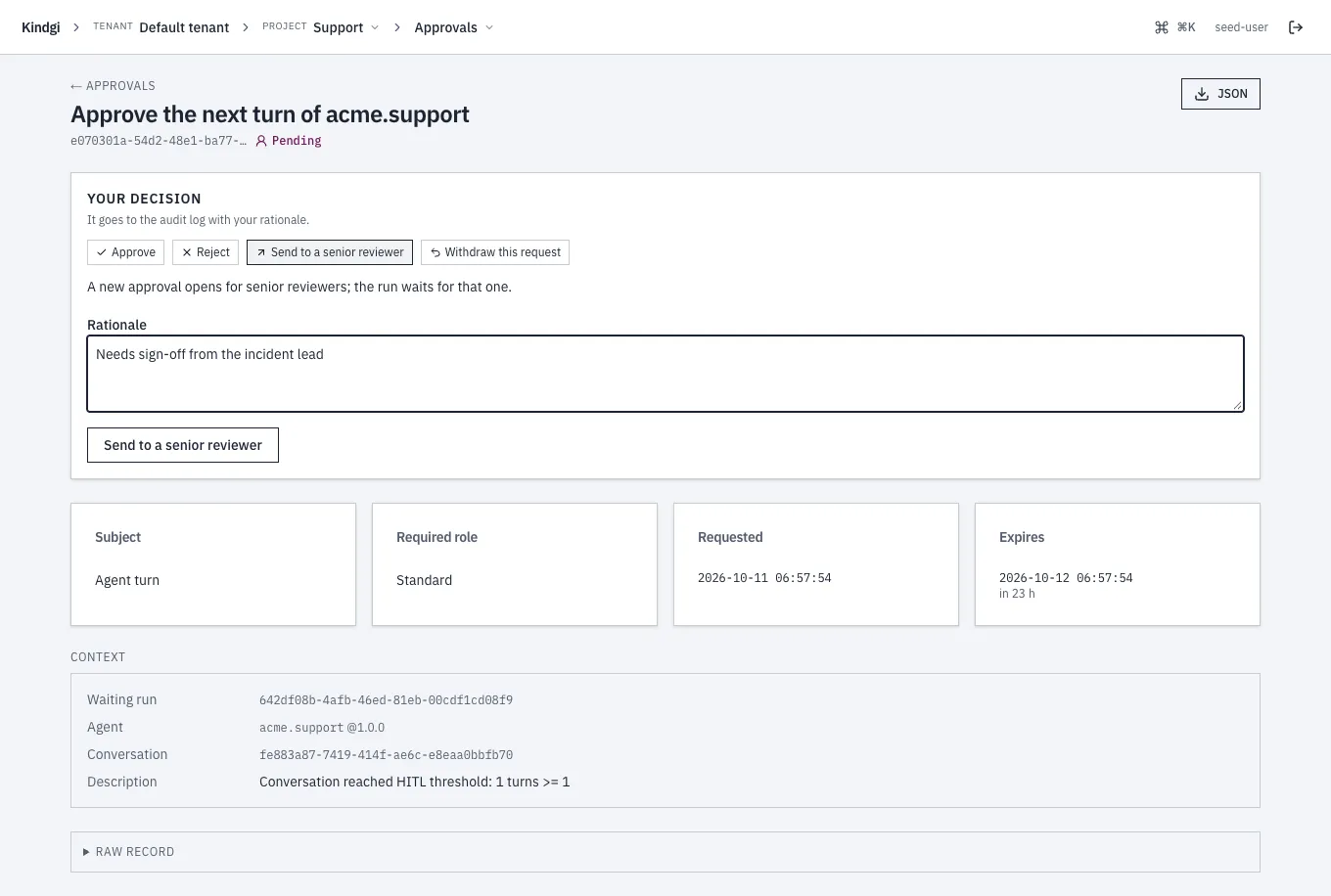
Section titled “In the console”An approval's page (or the Inbox, with it chosen) offers the decisions the reviewer may make, each saying what it does, and an optional rationale: "It goes to the audit log with your rationale." On a run's gate:
| Choice | What it says it does |
|---|---|
| Approve | "The waiting run goes on with it." |
| Reject | "The waiting run is told no: what it asked for does not happen." |
Send to a senior reviewer (Send to an admin reviewer on one that needs a senior; none at admin) |
"A new approval opens for senior reviewers; the run waits for that one." See Escalate. |
| Withdraw this request | "Nothing is decided, and the run waiting on it ends: it fails, saying the approval was withdrawn." See Withdraw. |
An agent promotion's approval says what each does to the version instead: "The version goes live where it was asked for.", or "The promotion is dropped; nothing changes where it runs." Once a decision is recorded, the page says what it did, such as "The waiting run continues." or "The waiting run is told no.", with Open the run.
- Someone who can't decide it reads why, in place of the choices: "You aren't on the reviewer roster, so you can't decide approvals. A tenant admin can add you.", or, below its role, "This one needs a senior reviewer."
- Whoever asked for it, a person or a service account, isn't offered
Approve when it needs someone else's (
separateApprover): "You asked for this, so someone else approves it." - A closed approval says why, when no decision does: "Withdrawn: its run was cancelled, so nothing is left to decide.", "Withdrawn: its run ended, so nothing is left to decide.", "Sent on to senior reviewers: that approval decides it." (with a link, and a link back from the one it was sent on to), or "It expired before anyone decided it."
- One decided or closed elsewhere while you were on it: "Someone decided it a moment ago: the page now shows how." or "It closed a moment ago: the page now shows why."
- One whose run already ended: the decision is refused, and the page says how the run ended and that nothing was recorded.
- The run, after a reject: its page says the run ended at its approval, as a review outcome, not an error: "A reviewer rejected it." (or that its approval was withdrawn, closed, or not decided in time), with your rationale (Start a run).
Several in one go
Section titled “Several in one go”In the Inbox, choose approvals with their checkboxes (or x, below). A bar
says how many are chosen, such as "3 chosen.", and offers Approve 3,
Reject 3 and Clear. Approving leaves out any you asked for that need
someone else's approval: "Approving leaves out 1 you asked for." You still
send on or withdraw an approval one at a time.
A step asks, for example, "Approve 3 approvals?", and takes one rationale
for all. Nothing is sent before you confirm. Then each approval is decided
on its own, in order, just as if you'd decided it alone, and each keeps its
own rules (its tier, who asked, who it's assigned to). Each rationale ends
"Decided in a batch of 3 (batch …).", with the batch's id. That's how you
find a batch's hitl-decision events in the audit trail. Stop after this
one leaves the rest unsent.
The step then says how each one went, with a line such as "1 approved; 1 refused; 1 not known (look before trying again)." Back in the Inbox, the line reads "In one go: …", and the decided ones leave the list.
- Refused means nothing was recorded for you, and it says why. One that closed while the batch ran says "It closed meanwhile (decided, withdrawn or expired); nothing was recorded for you."
- A rate limit is waited out, and the decision is tried again up to twice. One that's still limited after that is offered again with Try again what failed.
- Not known means the runtime failed or didn't answer, so the decision may or may not have been recorded: "Look at it before trying again." The batch never sends it again, and it stays chosen in the Inbox.
By keyboard
Section titled “By keyboard”The Inbox's keys work while the list has the focus (click a row, or Tab to
it), and never while you're typing in a field. ? lists them:
| Key | Does |
|---|---|
j / k |
Next / previous approval |
x |
Choose it for a batch |
a |
Approve: the rationale opens first; Enter records it |
r |
Reject: the same |
e |
Send on to the next tier: the same |
o |
Open its own page |
? |
These keys |
A key never decides by itself. a, r or e opens a step that asks, for
example, "Reject the next turn of acme.billing?", with the rationale box
focused. Enter records it, Shift+Enter starts a new line, and Esc leaves it.
If you can't make that decision, the step says why instead, such as "You
asked for this, so someone else approves it." or "It's at the top tier:
there's no one to send it on to."
Escalate
Section titled “Escalate”A standard reviewer who wants a second opinion escalates:
kindgi approvals complete 2134897a-d176-4ca8-b000-8bc00d79ad04 --decision=escalate --rationale="Needs sign-off from the incident lead"{ "kind": "escalated", "approval": { "id": "2134897a-d176-4ca8-b000-8bc00d79ad04", … "requiredRole": "standard", "status": "escalated", … }, … "nextApproval": { "id": "a65cd23c-1bdb-47d8-9b3a-aaec36475a4f", … "requiredRole": "senior", "status": "pending", … }, "waitpointResolved": false}The new approval needs a senior reviewer, so the standard reviewer no
longer sees it. A senior (or admin) reviewer approves or rejects
a65cd23c-…, and the run continues.
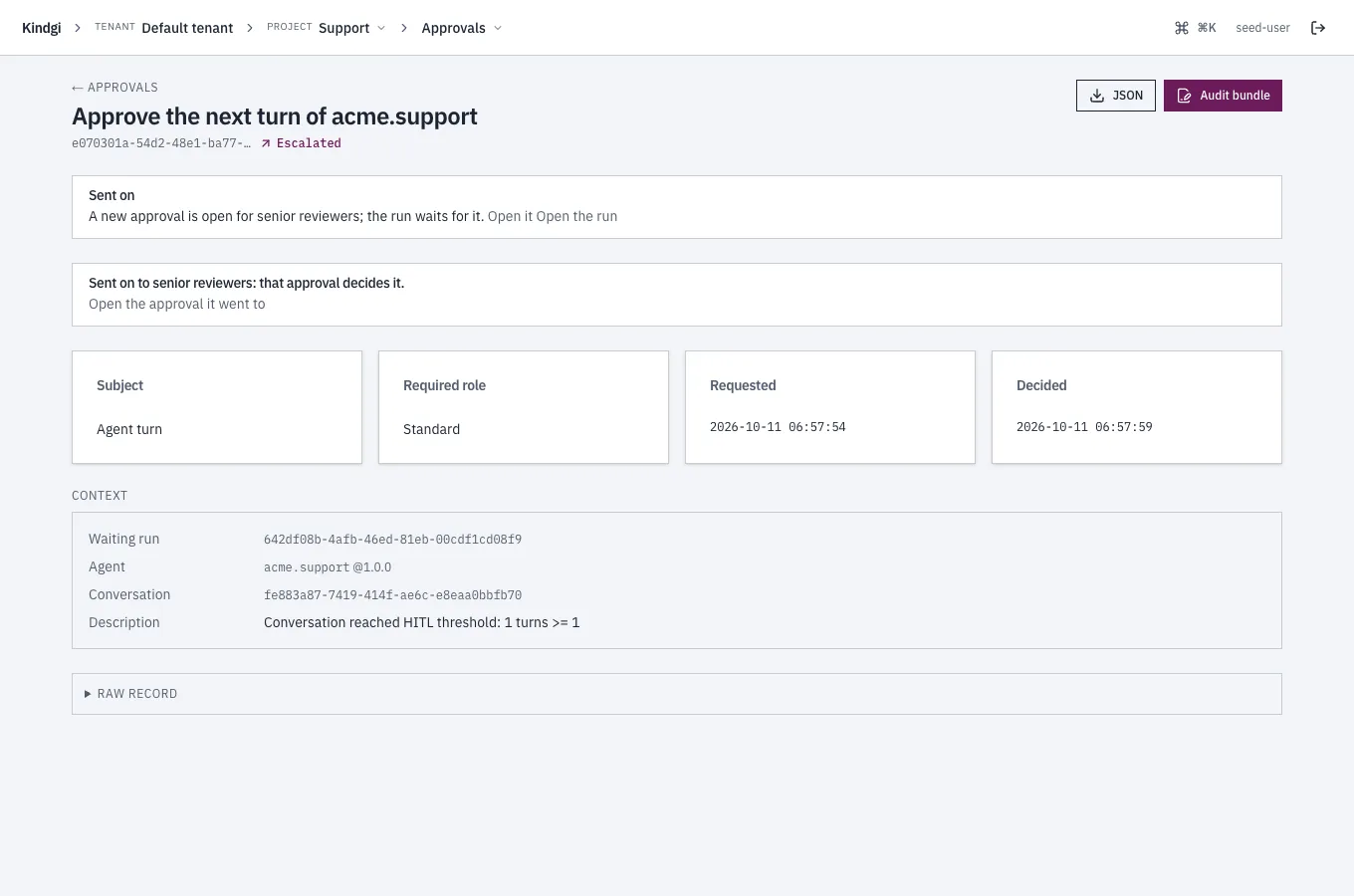
In the console, it's Send to a senior reviewer (to an admin one, on an
approval that needs a senior). The page then says "A new approval is open
for senior reviewers; the run waits for it.", with Open it, and from
then on "Sent on to senior reviewers: that approval decides it.", with
Open the approval it went to:
The new approval links back: "Sent on from an earlier approval: open it". It offers Send to an admin reviewer in its turn.
Withdraw
Section titled “Withdraw”Withdraw closes an approval without deciding what it asked, when the
request is moot. The run waiting on it can't go on, so it ends: its turn
fails with hitl-withdrawn ("The approval for tool call acme-desk.echo was
withdrawn").
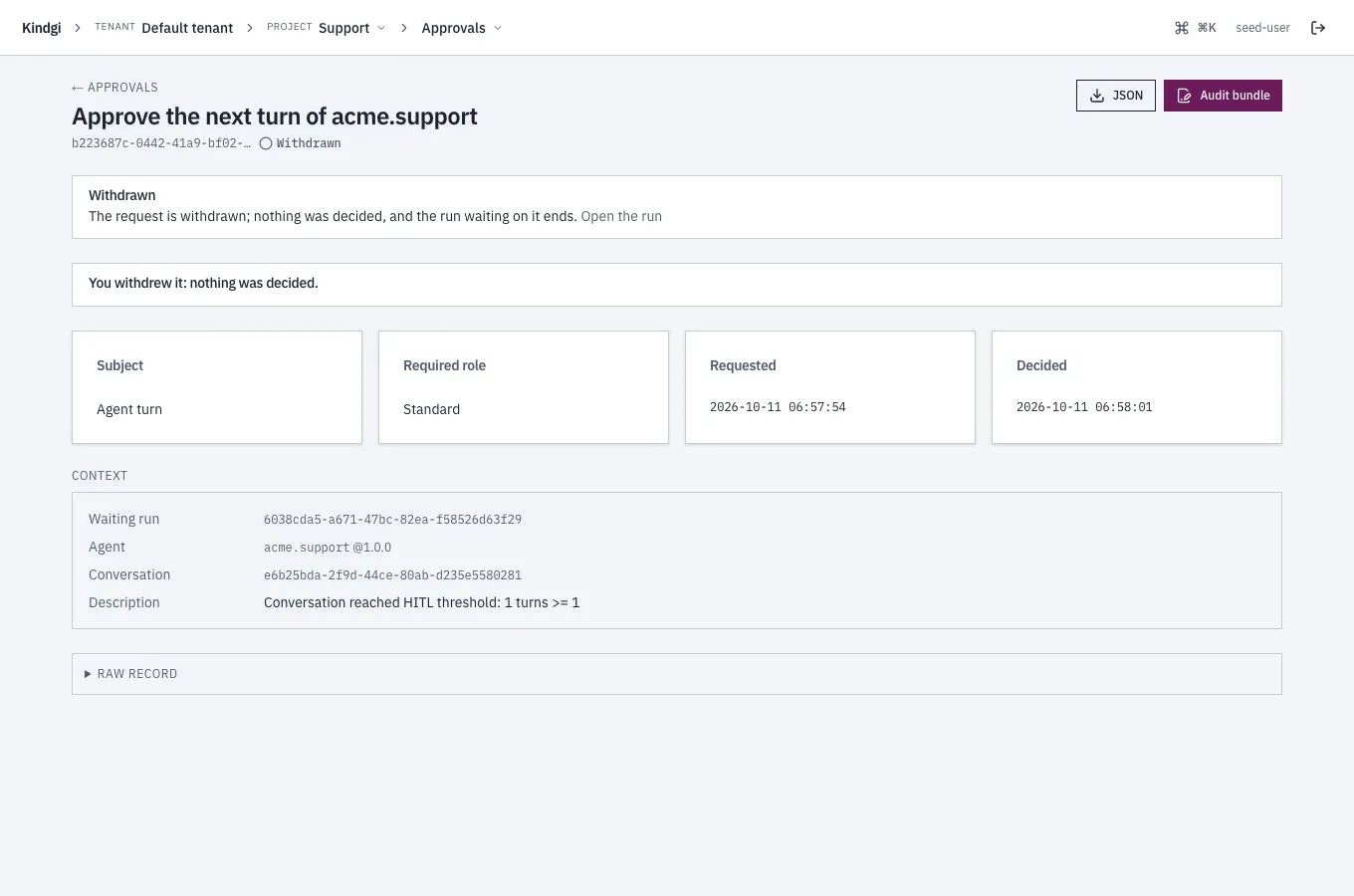
kindgi approvals complete <approval-id> --decision=withdraw --rationale="Asked by mistake"In the console, it's Withdraw this request. On a run's gate, the page
then says "The request is withdrawn; nothing was decided, and the run
waiting on it ends.", with Open the run, and from then on "You withdrew
it: nothing was decided." Its run fails with hitl-withdrawn ("The
approval for the session-HITL gate was withdrawn").
Cancelling a run withdraws the approvals it waits on by itself: see
Cancel a run.
Those approvals show withdrawnBecause: "run-cancelled" (or run-ended,
when a run ended otherwise while they waited, e.g. it failed) and no
decision. An approval a run asked for without waiting on it, such as a
project-wide memory fact's review or a memory erasure's, names the run only
as where it came from: it stays pending after the run ends, and is decided
as usual.
When nobody decides
Section titled “When nobody decides”Each approval has a deadline, its expiresAt: 24 hours after it's asked for,
or the agent's own hitl.timeoutMs (one hour:
conversationPolicy: { hitl: { tools: {}, timeoutMs: 3_600_000 } }). When the
deadline passes with no decision:
-
Below
admin, the approval becomesescalated, and a new one asks the next role up (standard, thensenior, thenadmin), with a deadline as long again. The run keeps waiting. -
At
admin, the approval becomesexpired, and the run's turn fails:"error":{"code":"hitl-cancelled","message":"Tool-call HITL cancelled for acme-desk.echo: timeout","reason":"timeout"}The run's
failuresays the same as data:code: "hitl-cancelled",reason: "timeout". Readreasonrather than the message; a runtime from before 0.1.6 doesn't send it, so go bycodealone there.
A decision made before the deadline always wins. A deadline always escalates
this way: hitl.onTimeout takes only 'escalate', the default. An agent that
asks for anything else is refused when it's defined:
hitl.onTimeout 'auto-approve' isn't supported: an approval that times out escalates one reviewer tier, and at admin it expires (the turn fails with hitl-cancelled). Use 'escalate', or leave it out.From your app
Section titled “From your app”A reviewer usually decides in your app, not in a terminal. The client lists the pending approvals and records the decision; the reviewer is the user the API token belongs to.
import { createClient } from '@kindgi/sdk/client';
const kindgi = createClient(); // KINDGI_API_URL, KINDGI_API_TOKEN, or the running kindgi dev
const pending = await kindgi.approvals.list({ status: 'pending' });for (const approval of pending.data) {  console.log(approval.id, approval.title, approval.subjectRef);}
const first = pending.data[0];if (first) {  const result = await kindgi.approvals.decide(first.id, {    decision: 'approve',    rationale: 'Checked the dashboard',  });  console.log(result.approval.status, result.waitpointResolved);}
46f0f9ad-f22d-4a93-8337-25b7c32a7473 HITL review: acme-ops.post-update { callId: 'dev-echo-call-1', toolId: 'acme-ops.post-update', agentId: 'acme-ops.status-agent', … arguments: { message: 'Checkout is slow for some customers.' }, …}approved truefrom kindgi.client import Kindgi
kindgi = Kindgi() # KINDGI_API_URL, KINDGI_API_TOKEN, or the running kindgi dev
pending = kindgi.approvals.list(status="pending")for approval in pending.data: print(approval.id, approval.title, approval.subject_ref)
if pending.data: result = kindgi.approvals.complete( pending.data[0].id, decision="approve", rationale="Checked the dashboard" ) print(result.approval.status, result.waitpoint_resolved)0afd1543-fe4e-45ca-af34-2effc1095bab HITL review: acme-ops.post-update {'callId': 'dev-echo-call-1', 'toolId': 'acme-ops.post-update', 'agentId': 'acme-ops.status-agent', …, 'arguments': {'message': 'Search is back.'}, …}approved Truelist takes a scope to see one project's approvals, or every project's in
an org: { kind: 'project', projectId } (scope_kind="project", scope_id=…)
or { kind: 'org', orgId }. An agent's approval is in its turn's project.
Approvals from before Kindgi 0.1.3 have no project, so only a list without a
scope shows them. runId lists the approvals one run asked for, and with
includeDescendants: true those of the runs inside it.
An approval also says:
- who asked for it (
requestedBy:user:<id>,service_account:<id>orsystem:<what>), and whether that person may approve it (separateApprover: truemeans they may not). ComparerequestedBywith the caller'sactorfromidentity.whoami()to leave out an Approve button they can't use. - where an escalation came from and went:
escalatedFromandescalatedTo, approval ids.