Propose a change, and test it
A proposal is new content for one data block an agent version pins (new settings values, or a new prompt template), for one live scope. You draft it; Kindgi publishes the block version, makes the agent version that runs it, compares it on a test set, and promotes it through the scope's gate when you ask. Nothing serves any scope until then, and a promoted proposal can be rolled back.
Before you start, you need:
- an agent that keeps its prompt or settings as data blocks (Change a prompt or a setting without a deploy);
- a judged test set for it (Build a test set from judgments);
- a live version of the agent for the whole tenant
(
kindgi agents promote <agent-id> <version> --tenant, Make a version live). Without one, the version a proposal makes would serve every scope nothing is pinned for, so evaluating is refused with409 proposal-needs-pin; - a deployed runtime. Under
kindgi dev, the pack is the source of agents, so evaluating is refused withregistry-read-only.
Draft one
Section titled “Draft one”kindgi proposals draft --agent=acme.rank.scorer --from-version=1.0.0 --tenant \ --block=acme.rank.weights --values='{"recency":0.2,"fit":0.8}' \ --hypothesis="Fit matters more than recency for acme rankings."It prints the proposal, with its id and the status draft:
{ "id": "3bca94f1-61a4-48b5-a3d7-f3664e466613", "agentId": "acme.rank.scorer", "fromVersion": "1.0.0", "scope": { "kind": "tenant" }, "tier": "settings-block", "change": { "blockId": "acme.rank.weights", "content": { "values": { "fit": 0.8, "recency": 0.2 } }, "fromVersion": "1.0.0" }, "hypothesis": "Fit matters more than recency for acme rankings.", "drafter": { "by": "user:62e1ffe2-30f4-4dff-948e-ae774107a7db", "kind": "person" }, "status": "draft", "createdAt": "2026-10-09T13:24:23.787Z", "updatedAt": "2026-10-09T13:24:23.787Z"}- What it changes:
--blocknames a block the version pins.--valuesgives a settings block's new values;--templategives a prompt block's new template. Either takes a file as@<file>. - For which scope:
--tenant,--org=<org-id>, or--project=<project-id>with--segment=<key:value>s for a segment. - Why:
--hypothesissays what the change should improve. Each--judgment=<judgment-id>(repeat it) keeps a judgment behind the change as evidence. - Checked now: the content is checked as publishing that block version would be, and content equal to what the version pins is refused. The same change from the same version for the same scope returns the proposal drafted before.
Drafting needs publish on the agent.
Evaluate it
Section titled “Evaluate it”kindgi proposals evaluate <proposal-id> --test-set=acme.rank-prompt-52080 --waitThe first evaluation publishes the block version and derives the agent
version that pins it (its derivedFrom names the proposal). Neither serves
any scope. The comparison replays the candidate on each case of the test set,
as Compare a version on a test set does, and
takes the same options: --objective, --reads, --repetitions, --k and
--class-weights.
The proposal is evaluating, then:
evaluated: the candidate beat the recorded outputs on the objective, by more than the noise;not-better: it didn't;evaluation-failed: the comparison failed or was cancelled.
--wait waits until then (at most 30 minutes) and prints the proposal.
Here the candidate scored the same as the recorded outputs on the test set's
20 cases (delta 0), so it's not-better:
{ "id": "3bca94f1-61a4-48b5-a3d7-f3664e466613", … "status": "not-better", "candidate": { "pinsDigest": "sha256:3425842179e45dc5a491306e59ba29f7c634a9f8cdf43e6b9af6809f153b3fa7", "agentVersion": "1.0.2", "blockVersion": "1.0.2" }, "evaluation": { "suiteId": "acme.rank-prompt-52080", "evalRunId": "aefcafd1-53df-480e-b01d-05ae55724507", "objective": "weightedYesShare", "startedAt": "2026-10-09T13:24:24.401Z", "runStatus": "completed", "baseline": 0.3333333333333333, "candidate": 0.3333333333333333, "delta": 0, "cases": 20, "better": false }, …}Judge the new answers, then rescore
Section titled “Judge the new answers, then rescore”A comparison counts what people have judged. When a change rewrites an
agent's answers, each new answer is an item no one has judged, so nothing on
the candidate's side is counted and the proposal can't be better. Here a
prompt change ("Answer briefly." to "Answer warmly.") rewrote the answer in
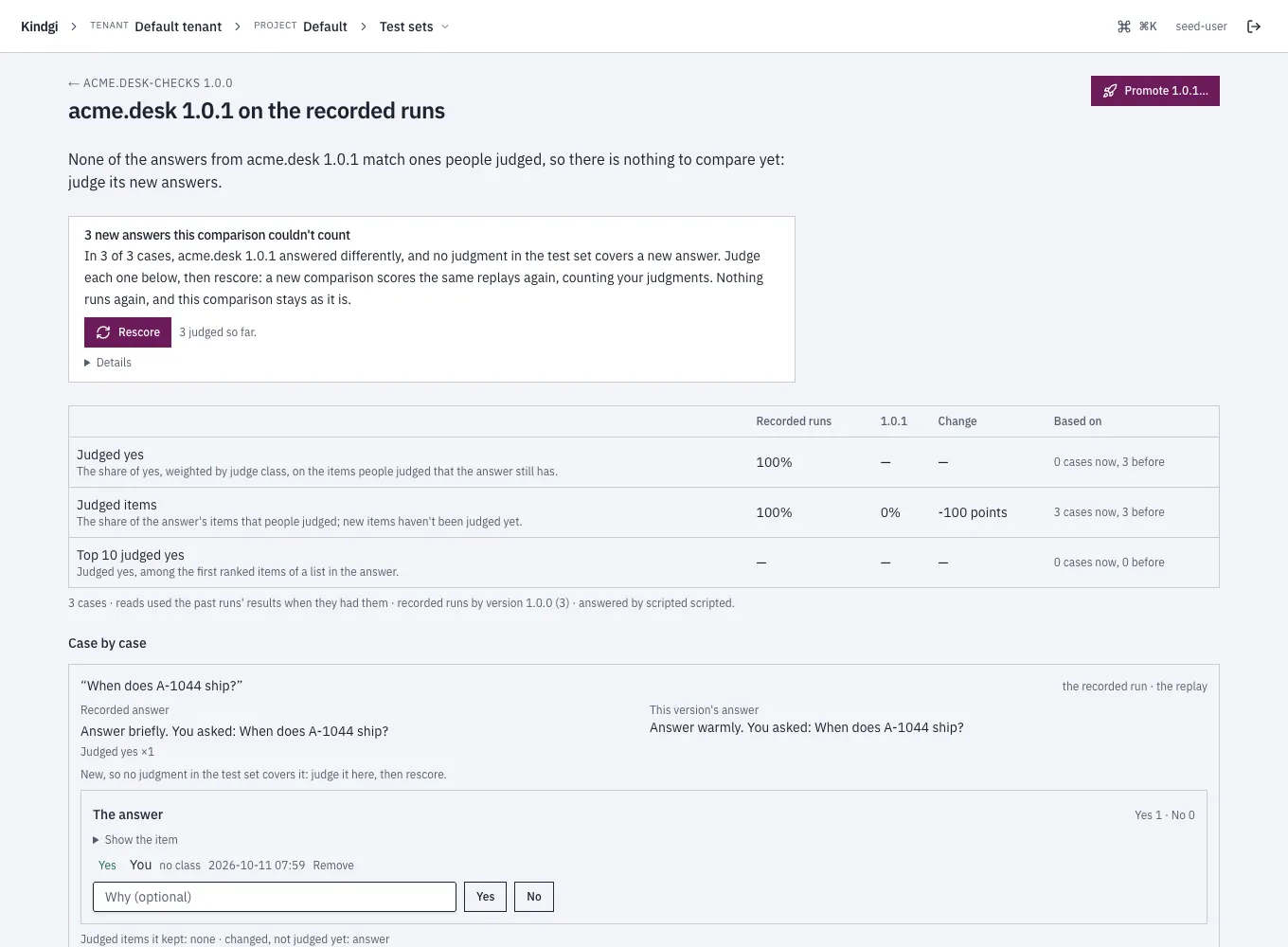
each of a test set's three cases. The comparison, the proposal's
evaluation.evalRunId, lists them case by case:
kindgi eval-runs show <eval-run-id>{ "runId": "941582fc-9e32-41bb-b148-767712664c6b", … "suiteId": "acme.desk-checks", "suiteVersion": "1.0.0", "kind": "judged", … "status": "completed", … "result": { "perCase": [ { … "caseId": "46b82ad4-1c2a-45f8-a593-a9c912964fd3", "runIds": ["c839338c-cfc1-4bf3-b4e3-c7f24e38a473"], "changes": { "new": [{ "key": "answer", "pointer": "/appended/1/content" }], "kept": [], "dropped": [{ "key": "answer" }] }, … }, … ], "summary": { … "metrics": { "judgedCoverage": { "n": 3, "delta": -1, "weight": 0, "baseline": 1, "baselineN": 3, "candidate": 0, "direction": "higher", "baselineWeight": 3 }, "weightedYesShare": { "n": 0, "delta": null, "weight": 0, "baseline": 1, "baselineN": 3, "candidate": null, "direction": "higher", "baselineWeight": 3 }, … }, … } }, …}runIds are the comparison's replay runs. Judge each new answer on its
replay run, at the pointer the comparison names. A replay's answer is at
/appended/1/content, not at a turn's /response/content; a pointer
that isn't in the run's output is refused (400 item-not-found):
kindgi judgments add --run=c839338c-cfc1-4bf3-b4e3-c7f24e38a473 --item=answer --pointer=/appended/1/content --yesThen rescore the proposal:
kindgi proposals evaluate <proposal-id> --rescore --waitA rescore is a new comparison, with the same test set version and settings,
that replays nothing: it scores the same replay runs again, with the
judgments made since, and becomes the proposal's evaluation. Here the three
new answers were judged good, as the old ones were, so the candidate scores
the same as the recorded outputs, and the proposal stays not-better.
Equal isn't better: a rescore that finds the candidate better makes it
evaluated.
{ "id": "9c8efe90-f4ac-4ce8-bb6f-5cd5ae7a043c", "agentId": "acme.desk", "fromVersion": "1.0.0", … "status": "not-better", "candidate": { "pinsDigest": "sha256:9ba29a87d32957a58fd798077b733c2a61e455a220e1c28ba4b1a97f10a49926", "agentVersion": "1.0.1", "blockVersion": "1.0.1" }, "evaluation": { "suiteId": "acme.desk-checks", "evalRunId": "e6d9ec9a-0341-4d18-a3f3-d8e1289f5dc0", "objective": "weightedYesShare", "startedAt": "2026-10-11T08:09:47.089Z", "runStatus": "completed", "baseline": 1, "candidate": 1, "delta": 0, "cases": 3, "better": false }, …}The new comparison says what it rescored, and how much of what it counts
was judged since. comparison.rescoreOf names the comparison rescored. Each
metric's freshWeight is the weight of those judgments, and per case,
candidate[].fresh and changes.new[].judged:
"comparison": { "k": 10, "reads": "recorded", "baseline": "recorded", "rescoreOf": "941582fc-9e32-41bb-b148-767712664c6b", "repetitions": 1 },…"weightedYesShare": { "n": 3, "delta": 0, "weight": 3, "baseline": 1, "baselineN": 3, "candidate": 1, "direction": "higher", "freshWeight": 3, "baselineWeight": 3 }- The comparison rescored stays as it was. A case whose replay run is
gone since (deleted with its retention, say) keeps the scores it had, with
rescored: false. - Rescoring needs
publishon the agent, fromevaluated,not-better,refused,supersededorexpired. - A comparison you started yourself, not through a proposal, rescores
with
kindgi eval-runs rescore <eval-run-id> --wait. - In the clients:
proposals.rescore(proposalId)andevalRuns.rescore(runId)(eval_runs.rescore(run_id)in Python).
In the console
Section titled “In the console”The comparison's page says what it couldn't count: "3 new answers this comparison couldn't count", and "Judge each one below, then rescore: a new comparison scores the same replays again, counting your judgments. Nothing runs again, and this comparison stays as it is." Each new answer has its own card, "New, so no judgment in the test set covers it: judge it here, then rescore.", with Yes and No. Rescore beside the note counts what you judged ("3 judged so far.").
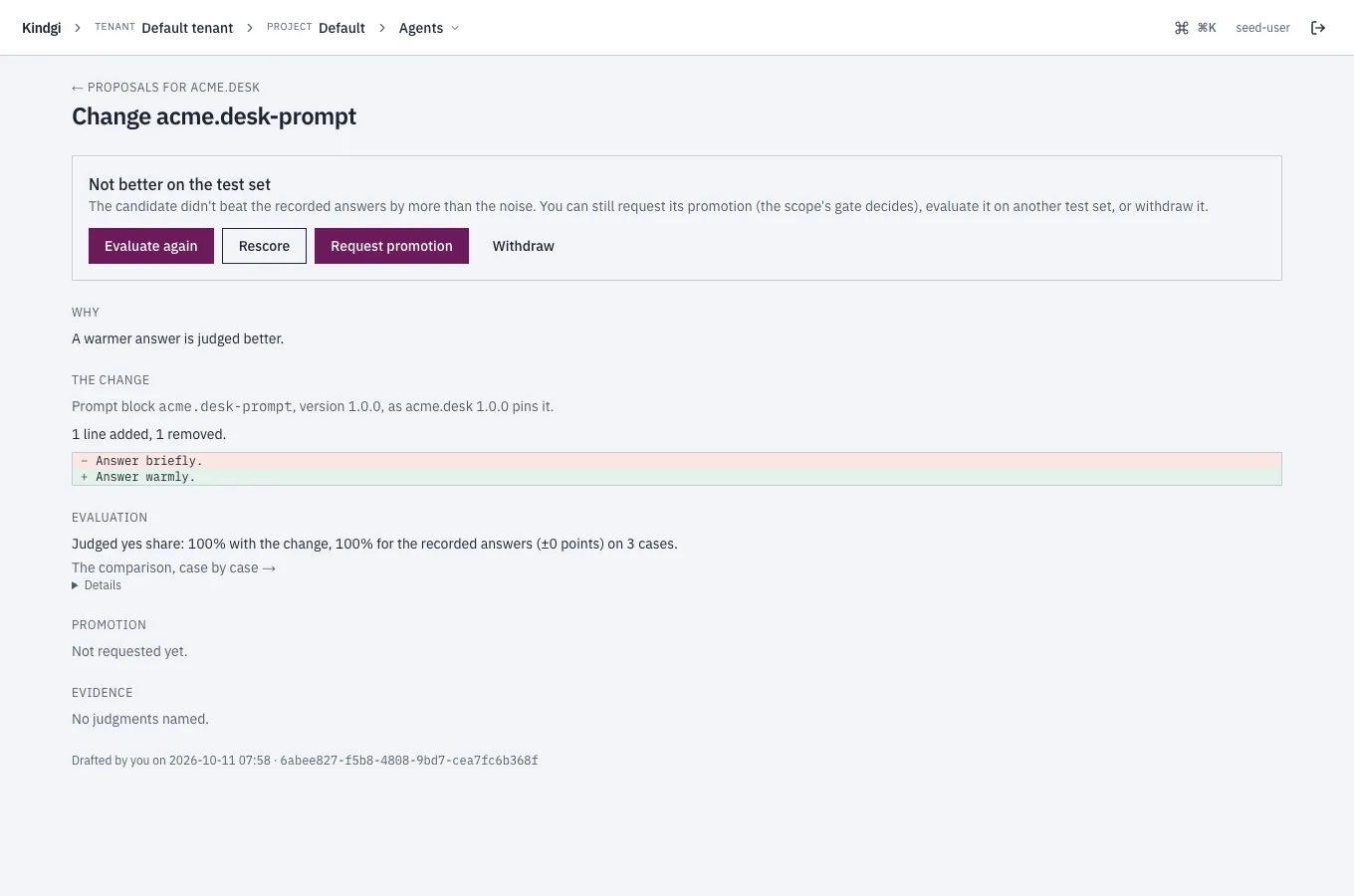
The proposal's page, while nothing could be scored, says "None of the candidate's answers could be scored: they changed, and nobody has judged the new ones yet. Judge them on the comparison, then rescore.", with a link to the comparison. Its Rescore asks first: "After people judge the comparison's new answers, a rescore counts them: it scores the same answers on acme.desk-checks again. Nothing runs again, and the earlier comparison stays as it is. The proposal's status follows the rescore." After it, the evaluation reads "Judged yes share: 100% with the change, 100% for the recorded answers (±0 points) on 3 cases.", and the proposal stays Not better on the test set.
Request it
Section titled “Request it”kindgi proposals request <proposal-id> --reason="Live check: promote by hand."This promotes the candidate for the proposal's scope, through the scope's gate, with the evaluation as its comparison (Gate a release). The proposal is then:
promoted: the candidate is live for the scope;in-review: the gate passed and a reviewer decides (kindgi approvals complete); thenpromoted,rejected, orexpiredif nobody decides in time, orsupersededif the scope's live version or its policy changed meanwhile;refused: the gate refused it, listing every check.
A request is allowed once the proposal was evaluated, not-better included:
the gate decides. The proposal above was not-better, and the tenant's gate
let it through:
{ "id": "3bca94f1-61a4-48b5-a3d7-f3664e466613", … "status": "promoted", … "promotion": { "id": "47319459-4131-4ef6-85c6-64afe0514900", "status": "promoted", "liveNow": true }, …}A proposal a pass wrote, rather than
a person, always waits for a reviewer, even where the scope's policy asks for
no approval. Requesting needs promote on the agent.
Roll it back, or withdraw it
Section titled “Roll it back, or withdraw it”kindgi proposals rollback <proposal-id> --reason="Live check: put it back."{ "id": "3bca94f1-61a4-48b5-a3d7-f3664e466613", … "status": "rolled-back", … "rolledBack": { "at": "2026-10-09T13:24:29.234Z", "by": "user:62e1ffe2-30f4-4dff-948e-ae774107a7db", "reason": "Live check: put it back.", "promotionId": "d19efc3c-d08a-44f8-8daa-8e2bdaedc1d8" }, …}kindgi proposals withdraw <proposal-id> --reason="Superseded by a better draft"rollbackputs the scope back on the version that served it before (rolled-back). The proposal and its versions stay, as history. It needspromoteon the agent.withdrawcloses a proposal before review, or after its promotion was refused, superseded or expired (withdrawn).--reasonis required. It needspublishon the agent.
Find them
Section titled “Find them”kindgi proposals list --agent=acme.rank.scorer --tablekindgi proposals get <proposal-id>The table has each proposal's agent version, scope, block, status, and the
evaluation's delta. --status, --tier=settings-block|prompt-block and a
scope flag (for exactly that scope) narrow the list. get shows the change,
the candidate versions, the comparison and the promotion. Proposals are
authorized on their agent: read to see one.
| Status | What it means |
|---|---|
draft |
Not evaluated yet. |
evaluating |
Its comparison is queued or running. |
evaluated |
The candidate beat the recorded outputs. |
not-better |
It didn't. |
evaluation-failed |
The comparison failed or was cancelled. |
in-review |
Requested; the gate passed and an approval is open. |
promoted |
Live for its scope. |
refused |
Requested; the gate refused it. |
rejected |
The reviewer rejected it. |
expired |
The approval expired undecided. |
superseded |
Approved after the scope's live version or policy changed. |
rolled-back |
Rolled back through the proposal. |
withdrawn |
Withdrawn. |
From your app, the clients have the same calls: proposals.create, list,
get, evaluate, rescore, request, rollback and withdraw.