Write a guardrail
This guardrail keeps an agent's answers short: it fails a turn whose answer is longer than a limit.
The guardrail
Section titled “The guardrail”import { defineCheck } from '@kindgi/sdk/define';import { z } from 'zod';
export const check = defineCheck({ id: 'my-pack.checks.answer-length', kind: 'zero-llm', configSchema: z.object({ maxChars: z.number().int().positive().default(500) }), evaluate: async (config, trace) => { const length = trace.output?.length ?? 0; if (length > config.maxChars) { return { passed: false, reason: `The answer is ${length} characters; the limit is ${config.maxChars}.`, }; } return { passed: true }; },});
export default { id: 'my-pack.answer-length', name: 'Answer is short', kind: 'zero-llm', check, config: { maxChars: 60 }, action: { 'on-violation': 'halt' }, severity: 'error',};The file has two parts:
- The check, from
defineCheck, exported ascheck. Itsevaluategets the guardrail's config and the turn's trace, and returns{ passed, reason? }. - The declaration, the default export: the guardrail's id, the check it
runs, the check's
config, and theactionon a failure.
from pydantic import BaseModel, Field
from kindgi import CheckResult, RunTrace, guardrail

class Config(BaseModel):    max_chars: int = Field(500, alias="maxChars", gt=0)

@guardrail(    id="my-pack.answer-length",    name="Answer is short",    on_violation="halt",    severity="error",    config={"maxChars": 60},)def answer_length(config: Config, trace: RunTrace) -> CheckResult:    length = len(trace.output or "")    if length > config.max_chars:        return CheckResult(            passed=False,            reason=f"The answer is {length} characters; the limit is {config.max_chars}.",        )    return CheckResult(passed=True)
@guardrail declares both parts: the function is the check, (config, trace),
def or async def; the decorator's arguments are the declaration. The
first parameter's type is the config's schema.
- The id is
<pack-id>.<name>. Name the rule as what should hold:answer-length,response-not-empty. kind: 'zero-llm': the check is your code, a function of the trace. It can't call a model.- The reason is what the violation reports. Say what was wrong. It shows wherever the failure does (the run's error, its page in the console), so describe what you blocked, never quote it: "it contains a card number", not the number.
- The trace has the turn's final answer (
output), its tool calls (toolCalls/tool_calls, each with the tool's name and arguments), their results, its model calls, the user's input and its cost. It also names the run's project (projectId/project_id) and, when the project has one, its org (orgId/org_id), set by the runtime, never from the input. SeeRunTracein the Python reference.
Put it on an agent
Section titled “Put it on an agent”An agent lists its guardrails:
// in agents/echo-agent/index.tsguardrails: ['my-pack.response-not-empty' as GuardrailId, 'my-pack.answer-length' as GuardrailId],The agent names the guardrail's id, not the check's.
# in agents/echo_agent.pyfrom ..guardrails.answer_length import answer_lengthfrom ..guardrails.response_not_empty import response_not_empty
# …    guardrails=[response_not_empty, answer_length],
Save. kindgi dev registers the guardrail with the rest of the pack. An
agent that names a guardrail that isn't registered doesn't run:
Error [unresolved-guardrail]: Agent "my-pack.gated" references guardrails not in the registry: my-pack.no-such-guardrailRun it
Section titled “Run it”dev-echo's answer, its "isn't a real model" line and the tool's result,
is longer than 60 characters, so the turn stops:
pnpm exec kindgi runs start --agent=my-pack.echo-agent --input='{"userMessage":"hi"}'Error [guardrail-violation]: Turn blocked by guardrail 'my-pack.answer-length': The answer is 243 characters; the limit is 60.uv run kindgi runs start --agent=my-pack.echo-agent --input='{"userMessage":"Ada"}'Error [guardrail-violation]: Turn blocked by guardrail 'my-pack.answer-length': The answer is 252 characters; the limit is 60.The command exits with status 1. The run's status is failed, and it has
no answer.
Stop a turn or record a violation shows what the run
records, and how to let the turn finish instead.
A check that throws fails the turn whatever its action, with the exception's
message (handler-throw: Check "…" evaluate() threw: …). Return
passed: false for a rule that isn't met; throw only when the check itself
can't run.
Test the check
Section titled “Test the check”import type { RunId, TenantId } from '@kindgi/sdk/types';import { expect, test } from 'vitest';
import { check } from './index.js';
const trace = (output: string) => ({ runId: 'run-1' as RunId, tenantId: 'test-tenant' as TenantId, output, toolCalls: [], toolResults: [], modelCalls: [], mode: 'runtime' as const,});
test('passes a short answer', async () => { expect(await check.evaluate({ maxChars: 60 }, trace('Shipped.'), {})).toEqual({ passed: true });});
test('fails a long answer, with a reason', async () => { const result = await check.evaluate({ maxChars: 5 }, trace('Shipped yesterday.'), {}); expect(result.passed).toBe(false); expect(result.reason).toBe('The answer is 18 characters; the limit is 5.');});pnpm exec kindgi test ✓ guardrails/answer-length/index.test.ts (2 tests) 2ms… Tests 7 passed (7)from kindgi import RunTracefrom guardrails.answer_length import Config, answer_length
def test_a_short_answer_passes(): trace = RunTrace(run_id="r", tenant_id="t", output="Shipped.") assert answer_length(Config(maxChars=60), trace).passed
def test_a_long_answer_fails_with_a_reason(): trace = RunTrace(run_id="r", tenant_id="t", output="Shipped yesterday.") result = answer_length(Config(maxChars=5), trace) assert not result.passed assert result.reason == "The answer is 18 characters; the limit is 5."uv run pytest........ [100%]8 passed in 0.19sIn the console
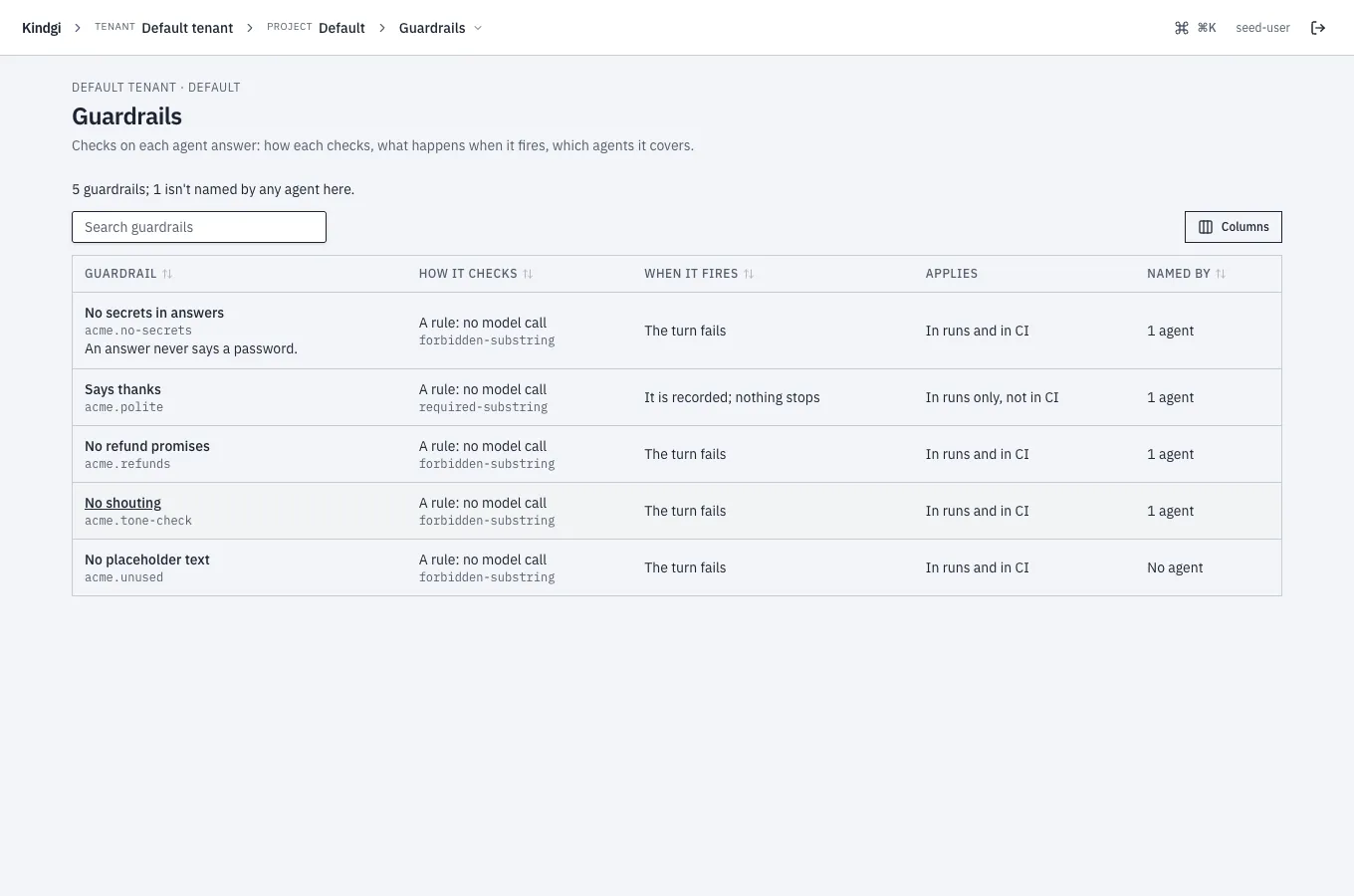
Section titled “In the console”A project's Guardrails page lists its guardrails, with a headline such as "5 guardrails; 1 isn't named by any agent here." Each row says:
- how it checks: "A rule: no model call", with the check;
- what happens when it fires: "The turn fails", or "It is recorded; nothing stops";
- when it applies: "In runs and in CI", or "In runs only, not in CI";
- how many agents name it: "1 agent", or "No agent".
A guardrail's page has:
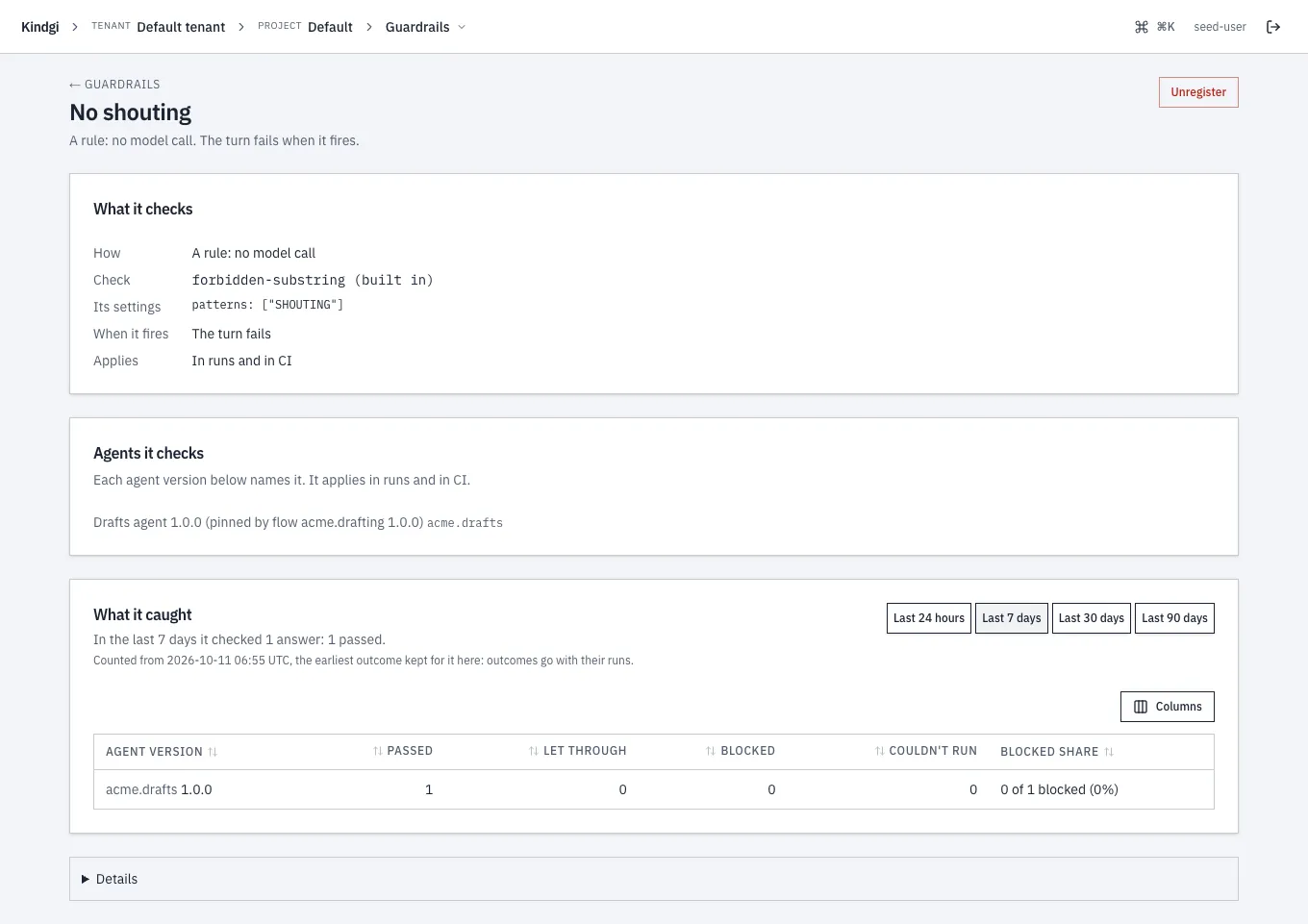
- What it checks: how, the check, its settings, when it fires, its severity and where it applies.
- Agents it checks: each agent version that names it and can run here, marked "(latest)" or "(live)".
- What it caught: its outcomes by agent version (Halt or record).
![No secrets in answers' page: a rule, forbidden-substring (built in), patterns ["password"], the turn fails, critical, in runs and in CI; the agent version that names it, Guarded agent 1.0.0 (latest); and What it caught.](/_astro/guardrail-page.DKrV3HW3_TOXaK.webp)
A flow step runs the agent version its flow version pins, so that version is checked too: "Drafts agent 1.0.0 (pinned by flow acme.drafting 1.0.0)".
For guardrail admins, Unregister. Its dialog names the agent versions whose turns then fail, and how they come back:
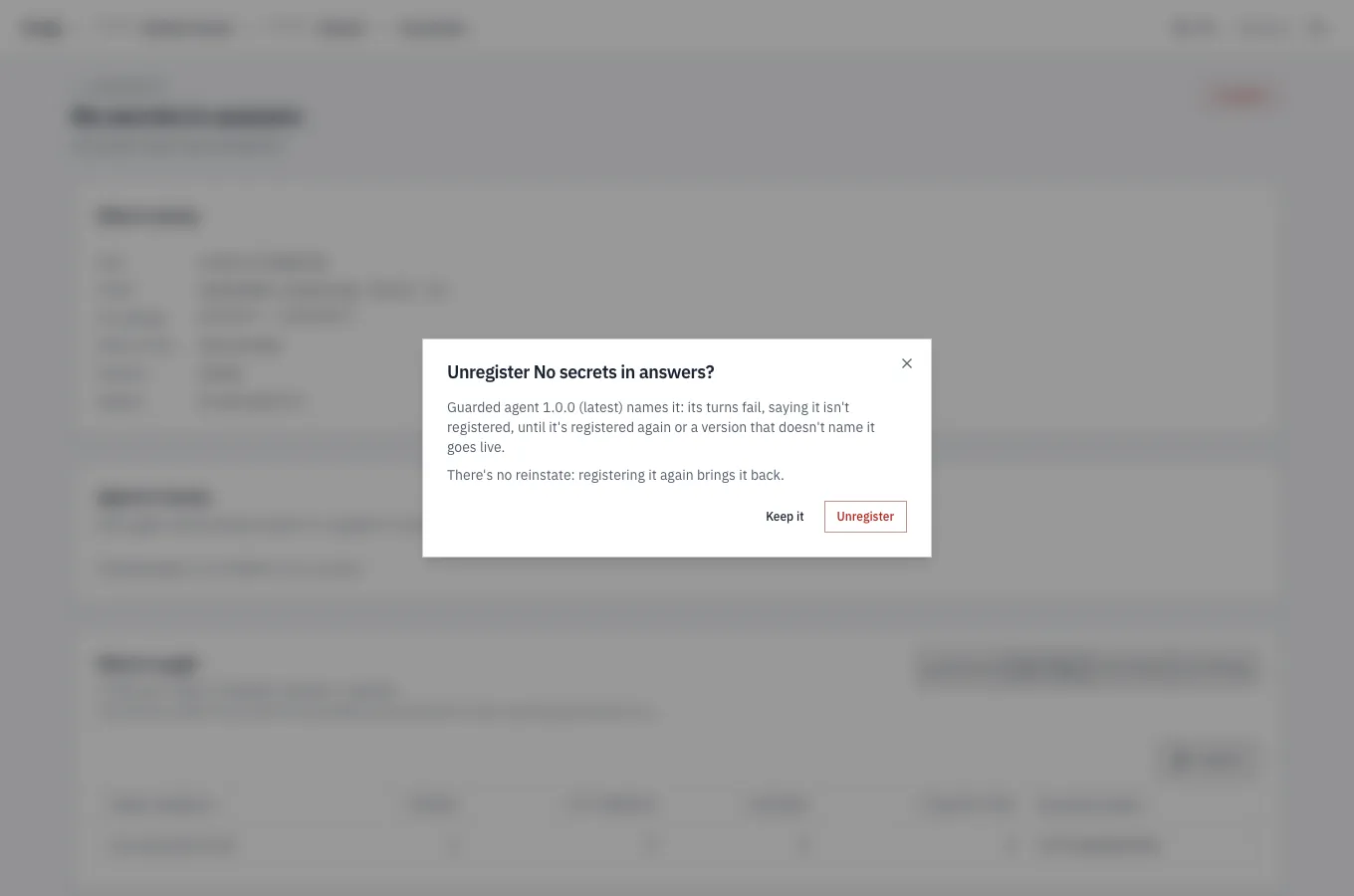
Unregister No secrets in answers?Guarded agent 1.0.0 (latest) names it: its turns fail, saying it isn't registered, until it's registered again or a version that doesn't name it goes live.There's no reinstate: registering it again brings it back.- When a flow pins one of those versions, it adds: "The flow version that pins it fails at that step too: …".
- Once it's done, the dialog shows the guardrail's definition, to register it again.
- Past 100 agents or flows, the page and the dialog say which weren't checked: "Only the first 100 agents were checked." (or the first 100 flows' steps).