

Stop a turn or record a violation
This guide chooses what a failed guardrail does to an agent's turn: stop it, send the answer back for a new one, or let it finish and record the failure.
Before you start
Section titled “Before you start”- The answer-length guardrail from
Write a guardrail, in the pack
my-pack, withkindgi devrunning and Kindgi 0.2's CLI. KINDGI_API_URLandKINDGI_API_TOKENset in your shell, to count a guardrail's outcomes: your runtime's URL and its API token.
Choose the action
Section titled “Choose the action”A guardrail's action decides what a failed check does to the turn:
haltstops it. The turn fails withguardrail-violation, and the run has no answer.retrysends the answer back. The model gets the check's reason and writes a new answer, up to a number of answers you set: see Send the answer back.log-onlylets it finish. The answer goes out, and the failure is recorded on the turn as a violation.
That's at the final answer, where a guardrail runs by default. A guardrail that runs at a tool call or a model reply acts there instead: At a tool call or a model reply.
Ask your coding agent, for example: "When my answer length guardrail fails, don't stop the turn. Just record it." Kindgi's skills in your pack tell it how (How it knows Kindgi). For reference, it sets the action like this:
// in guardrails/answer-length/index.tsaction: { 'on-violation': 'log-only' },# in guardrails/answer_length.py@guardrail( id="my-pack.answer-length", name="Answer is short", on_violation="log-only", severity="error", config={"maxChars": 60},)// in src/main/java/mypack/guardrails/AnswerLength.java .onViolation("log-only")// in src/main/scala/mypack/guardrails/AnswerLength.scala .onViolation("log-only")A halted turn
Section titled “A halted turn”With halt, starting a run fails with the check's reason:
pnpm exec kindgi runs start --agent=my-pack.echo-agent --input='{"userMessage":"hi"}'uv run kindgi runs start --agent=my-pack.echo-agent --input='{"userMessage":"hi"}'./kindgiw runs start --agent=my-pack.echo-agent --input='{"userMessage":"hi"}'./kindgiw runs start --agent=my-pack.echo-agent --input='{"userMessage":"hi"}'--agent is the agent the guardrail is on, and --input its input.
Error [guardrail-violation]: Turn blocked by guardrail 'my-pack.answer-length': The answer is 243 characters; the limit is 60.The run is failed, and its failureMessage carries the violation. Get
the run:
pnpm exec kindgi runs get <run-id>uv run kindgi runs get <run-id>./kindgiw runs get <run-id>./kindgiw runs get <run-id><run-id> is the failed run's id. kindgi runs list shows it first.
{ "id": "5202d750-e510-483f-991a-db34c6cba950", … "flowId": "agent.turn", "status": "failed", … "failureMessage": "{\"__agent_turn_failure__\":true,\"error\":{\"code\":\"guardrail-violation\",\"message\":\"Turn blocked by guardrail 'my-pack.answer-length': The answer is 243 characters; the limit is 60.\",\"violations\":[{\"guardrailId\":\"my-pack.answer-length\",\"result\":{\"passed\":false,\"reason\":\"The answer is 243 characters; the limit is 60.\"},\"action\":\"halt\",\"severity\":\"error\",\"at\":\"2026-10-03T20:10:37.910Z\"}],\"evaluationErrors\":[]}}"}In the console, the run's page keeps the answer the model wrote in view, muted, under Blocked by a guardrail, not sent: the answer the model wrote, with the guardrail under Which guardrail. A turn that failed for another reason after its answer says Not sent: the turn failed after the model wrote this answer.
Use halt for a rule whose failure makes the answer unusable or unsafe to
show.
A recorded violation
Section titled “A recorded violation”With log-only, the turn completes, and its output lists the violation:
"status": "completed", … "output": { … "response": { "role": "agent", "actor": "my-pack.echo-agent", "content": "⚠ dev-echo isn't a real model: it only repeats what it's given. Add an LLM provider key (Anthropic, OpenAI, Gemini, Groq, OpenRouter…) to get real answers.\n\nTool responded: {\"echo\":\"hi\",\"echoedAt\":\"2026-10-07T13:20:06.619Z\",\"characterCount\":2}", … }, … "violations": [ { "at": "2026-10-03T20:10:57.958Z", "action": "log-only", "result": { "passed": false, "reason": "The answer is 243 characters; the limit is 60." }, "severity": "error", "guardrailId": "my-pack.answer-length" } ],Use log-only while you find out how often a new rule fails, or for a rule
your app acts on itself: read violations from the turn's result.
Send the answer back
Section titled “Send the answer back”With retry, a failed check neither stops the turn nor lets the answer out.
The answer goes back to the model with the check's reason, and the model
writes a new one. retry.maxAttempts counts the answers the guardrail fails,
the first one included:
// in guardrails/answer-length/index.tsaction: { 'on-violation': 'retry', retry: { maxAttempts: 3 } },# in guardrails/answer_length.py@guardrail( id="my-pack.answer-length", name="Answer is short", action={"on-violation": "retry", "retry": {"maxAttempts": 3}}, severity="error", config={"maxChars": 60},)// in src/main/java/mypack/guardrails/AnswerLength.java .action(Map.of("on-violation", "retry", "retry", Map.of("maxAttempts", 3)))// in src/main/scala/mypack/guardrails/AnswerLength.scala .action(Map("on-violation" -> "retry", "retry" -> Map("maxAttempts" -> 3)))-
maxAttemptsis 1 to 10. With 3, the guardrail sends a failed answer back up to twice, and the third answer it fails ends the turn. Left out, it's 2: one answer is sent back. With 1, nothing is sent back, and the first failure fails the turn. Eachretryguardrail counts its own, so a turn with two of them can have more answers than either allows. -
The model reads why. After the failed answer, the turn adds a user message that names the guardrail and the check's reason:
[kindgi:guardrail-retry] ["my-pack.answer-length"]Your answer wasn't sent: it didn't pass this guardrail.- my-pack.answer-length: The answer is 243 characters; the limit is 60.Write a new answer that meets it.Neither the failed answer nor the note is stored in the conversation: only the answer that's sent is. Each answer's tool calls are stored, as always.
-
Out of answers, the turn fails as a halted one does, with
guardrail-violation.details.attemptssays how many answers it had, and so does the message: "Turn blocked by guardrail 'my-pack.answer-length' after 3 answers: The answer is 243 characters; the limit is 60." Each answer is a model call, so the agent'sbudget.maxStepsbounds them too, and so does the turn's own limit of 32 model calls: when either runs out first, the turn fails the same way. -
haltcomes first. With aretryguardrail at the final answer, the agent'shaltandretryguardrails there judge each answer, and a failedhaltfails the turn at once. The other guardrails at the final answer (log-onlyand the rest) judge only the answer that's sent. -
A new answer can do what the first one could. The model still has the turn's tools, and can call them again, side-effecting ones included. A call that needs an approval needs one again.
-
Each answer costs its checks. A
haltorretryjudge guardrail's calls run once for each answer, so as often as the turn has answers. They don't count toward the agent'sbudget.maxCostUsd. -
A restart costs one more check. If the runtime restarts while a turn is finishing, the turn it picks up judges its last answer on its
haltandretryguardrails again, and those checks are counted again. If aretrycheck fails this time, the turn fails as out of answers. -
A dry run skips the model call: its answer is a placeholder, and nothing is sent back. A
retryguardrail that fails that answer fails the turn, as one out of attempts does.
At a tool call or a model reply
Section titled “At a tool call or a model reply”A guardrail whose at is 'before-tool', 'after-tool' or 'model-step'
judges a step of the turn before the step takes effect
(Where in the turn it runs).
In a Python, Java or Scala pack, a guardrail runs at the final answer only.
Its action applies to that step:
- Before a tool call. With
halt, the turn fails withguardrail-violation, and the call doesn't run. Withretry, the call is refused: it doesn't run, and the model gets the guardrail's reason as the call's result, so it can go on without the call or make another one. - After a tool call. The call has run. The guardrail judges what it
returned, or the error it threw, before the model sees it. With
halt, the turn fails. Withretry, the result is withheld: the reason is stored as the call's result in its place, so neither the model nor a later turn's history sees the result. In a replay, the call's recorded result is judged as a live one is. - On a model reply that asks for tool calls. With
halt, the turn fails before any of the calls runs. Withretry, the reply is sent back: none of its calls runs, nothing of it is stored, and the model writes a new reply. - With
log-only, the step goes ahead, and the failure joins the turn'sviolations. - A dry run skips the model call, so its reply asks for no tools and no guardrail runs at these points.
With halt, the message says where the turn stopped. For the refund-limit
guardrail from
Check a tool call or a reply:
Error [guardrail-violation]: Turn blocked by guardrail 'my-pack.refund-limit' before calling acme.orders.refund: The refund is 250; the limit is 100.With retry, the model gets this as the refused call's result:
[kindgi:guardrail-retry] ["my-pack.refund-limit"]This call didn't run: it didn't pass this guardrail.- my-pack.refund-limit: The refund is 250; the limit is 100.Don't make this call again as it is. Go on without it, or make a call that meets it.A withheld result's note says the call ran and its result is withheld, and ends "Go on without its result." A reply that's sent back gets a user message instead, which says the reply wasn't acted on and none of its tool calls ran, and asks for a new reply.
- Attempts count across the turn, one for each reply.
retry.maxAttemptscounts the model's replies the guardrail acted on, the first one included: a reply it sent back, or one with a call it refused or a result it withheld. Two calls of one reply that it refuses are one attempt, since the model hasn't seen either refusal yet, and two guardrails that act on one reply count it once each. When they run out, or the turn has no steps left, the turn fails withguardrail-violation, anddetails.attemptssays how many replies there were: "Turn blocked by guardrail 'my-pack.refund-limit' before calling acme.orders.refund, after 2 replies: The refund is 250; the limit is 100." A tool's own result never counts as an attempt, whatever its text. - The record says where. A failed turn's
details.pointnames the point, and at a tool calldetails.callIdnames the call. Theguardrail.violatedandguardrail.errorevents carry both, and so does the guardrail'sguardrail-checknode in the run's provenance. - A resumed turn decides nothing twice. Each check's outcome at a point is recorded with the step. A turn resumed after an approval, or a step run again, reuses it: no judge is asked or billed again, and no event is sent again.
- The final answer runs only the guardrails at the final answer. Its trace still holds every tool call the model asked for.
When the check can't run
Section titled “When the check can't run”A guardrail whose check can't run at all never counts as passed. A check can't run when:
- no check by that name is registered. At the final answer that's
unknown-check. At a tool call or a model reply, such a check counts as one that runs at the final answer only, so it fails ascheck-point-unsupported, and the message says no check by that name is registered; - its configuration is invalid;
- an
llm-judgeguardrail's judge can't be routed to a model; - with a pack service for each deployment, the check's pack isn't deployed into the run's project;
- the check throws, because pack code crashed or a pack service couldn't be reached;
- the guardrail runs at a point its check doesn't run at
(
check-point-unsupported, with the check's id and the point); - at a tool call or a model reply, the check runs past its time limit
(
check-timed-out, withlimitMs), as How long its check may take describes.
What happens next depends on the action:
-
With
halt, the turn fails withguardrail-violation. Itsviolationsis empty,evaluationErrorsnames the guardrail, and the message says why. Here a guardrail at the final answer names a pack check that nothing deployed:Error [guardrail-violation]: Turn blocked: guardrail 'acme.pack-only' couldn't run its check (unknown-check: Guardrail "acme.pack-only" references unregistered check "acme.checks.not-deployed")At a tool call or a model reply, the message also says where:
Error [guardrail-violation]: Turn blocked before calling acme.orders.refund: guardrail 'my-pack.refund-limit' couldn't run its check (check-timed-out: Guardrail "my-pack.refund-limit"'s check "my-pack.checks.refund-limit" ran past 10000 ms: the turn stopped waiting for it and cancelled it) -
With
retryat the final answer, the error doesn't send the answer back: the turn goes on as if the check had passed. -
With
retryat a tool call or a model reply, the error counts as a failed check: the call is refused, the result withheld or the reply sent back, with the reasonits check couldn't run (<code>): <message>. So withhaltorretry, a check that can't run never lets a call through. -
With any other action, the turn completes.
Where each deployment has its own pack service, as on Kindgi Cloud
(A pack service for each deployment),
a guardrail's pack check runs from a pack deployed into the run's project,
which is the guardrail's own, never from one in another project. So a
guardrail that names a check deployed into another project can't run it,
and the message ends:
A guardrail's pack check runs from a pack deployed into the run's project.
Either way, at the final answer, the error is recorded in two places. The
run's provenance has the guardrail's node, with evaluated: false. The run
journal's evaluate-guardrails step has it under errors. At a tool call
or a model reply, the error is in the guardrail.error event and the
guardrail's guardrail-check node in the provenance, with the point and,
at a tool call, the call.
In a turn with a retry guardrail at the final answer, the halt and
retry guardrails there check each answer in the agent loop's
budget-check step. A halt error there
fails that step: provenance has the guardrail's node, as above, and the
journal has the error on that step. An error on an answer that's sent back
is in the guardrail's outcomes, as errored,
but not in provenance or under errors: those show the answer that's sent.
Severity
Section titled “Severity”severity is info, warn, error or critical. It's recorded with each
violation, and doesn't change what the action does: a log-only guardrail
can be critical.
Which agents it covers
Section titled “Which agents it covers”A guardrail checks the turns of every agent that lists it. scope narrows
that. Ask your coding agent, for example: "Check answer length only on my
echo agent." For reference, it sets the scope like this:
// in guardrails/answer-length/index.tsscope: { when: 'always', agents: ['my-pack.echo-agent'] },# in guardrails/answer_length.pyscope={"when": "always", "agents": ["my-pack.echo-agent"]},// in src/main/java/mypack/guardrails/AnswerLength.java .set("scope", Map.of("when", "always", "agents", List.of("my-pack.echo-agent")))// in src/main/scala/mypack/guardrails/AnswerLength.scala .set("scope", Map("when" -> "always", "agents" -> Seq("my-pack.echo-agent")))agentslists the agents the guardrail applies to. An agent that lists the guardrail but isn't in its scope isn't checked.flowslists flows, by id. The guardrail then checks only the turns a step of one of those flows starts, and replays of those turns: an agent's turn in another flow's step, or outside any flow, isn't checked. Withagentsas well, a turn must match both. To find a turn's flow, the runtime reads the turn's runs, and only for a turn with a guardrail that listsflows. If it can't read them, or the run a replay replays is gone, the turn fails withpersistence-errorrather than go unchecked.whenisalways,runtime-onlyorci-only. Aci-onlyguardrail doesn't run in an agent's turn.toolslists tools, by id, for a guardrail that runs before or after a tool call, as Where in the turn it runs describes.
A turn the scope leaves out isn't counted in the guardrail's outcomes either.
How a guardrail is doing
Section titled “How a guardrail is doing”Every check a guardrail runs on an agent's answer is recorded with its
outcome: once a turn, or, for a halt or retry guardrail, once an answer
when the turn has a retry guardrail
(Send the answer back). One request
counts them over a window, for a project. The console
shows the same counts.
From the API
Section titled “From the API”Here acme.no-secret halts on SECRET, on an agent at versions 2.0.0 and
2.1.0. Each version answered two questions and was asked for the secret
once. Count its outcomes:
curl -s -H @<(printf 'Authorization: Bearer %s\n' "$KINDGI_API_TOKEN") \ "$KINDGI_API_URL/v1/guardrails/acme.no-secret/outcomes?projectId=a1e2b238-ae0b-4f03-b012-07875b9e5ee0&from=2026-10-11T06:02:19Z&to=2026-10-11T06:05:22Z"acme.no-secretis the guardrail's id.projectIdis the project whose turns are counted.fromandtoare the window, at most 90 days apart.recent, left out here, is how many blocked turns to name: 0 to 50, 10 by default.
Reading it takes read on the guardrail and on the project. The clients call
it guardrails.outcomes. It answers:
{ "guardrailId": "acme.no-secret", "from": "2026-10-11T06:02:19.000Z", "to": "2026-10-11T06:05:22.000Z", "counts": { "passed": 4, "violated": 0, "blocked": 2, "errored": 0 }, "byAgentVersion": [ { "agentId": "acme.desk", "agentVersion": "2.0.0", "passed": 2, "violated": 0, "blocked": 1, "errored": 0 }, { "agentId": "acme.desk", "agentVersion": "2.1.0", "passed": 2, "violated": 0, "blocked": 1, "errored": 0 } ], "recentBlocked": [ { "runId": "4566d55d-6d49-43d2-be14-2b1419611f71", "at": "2026-10-11T06:04:20.202Z", "agentId": "acme.desk", "agentVersion": "2.1.0" }, { "runId": "2e462cfd-7597-4c72-9fb7-1152141e46ee", "at": "2026-10-11T06:04:05.906Z", "agentId": "acme.desk", "agentVersion": "2.0.0" } ], "recordedSince": "2026-10-11T06:03:57.454Z"}What each outcome means
Section titled “What each outcome means”passed: the check ran and found nothing.violated: the check found something, and the answer went through:log-only,noop, or an action handed back. See A recorded violation. Aretryguardrail that sent the answer back counts here too.blocked: the check found something, and itshaltfailed the turn, or aretryguardrail's last answer did. See A halted turn.errored: the check couldn't run, as When the check can't run lists. Ahaltguardrail's error fails the turn too, and is counted here, not asblocked.
The counts are of answers judged, not of turns. Take a turn whose first
answer a retry guardrail sent back and whose second passed: it counts one
violated and one passed for that guardrail, and two checks for each of
the agent's halt guardrails. A blocked turn is named once in
recentBlocked.
A turn the guardrail's scope didn't cover wasn't checked, so it isn't counted. Neither are replays and dry runs.
By agent version
Section titled “By agent version”byAgentVersion has the same counts for each version of each agent, up to
100 versions, the most checked first. It shows whether a new version trips
the guardrail more or less than the last. recentBlocked names the latest
blocked turns, newest first, by run id and time only: a blocked answer stays
behind its run's page.
Outcomes go with their run's retention. recordedSince is the earliest one
kept for the guardrail in the project, so a window that starts before it
holds fewer than you asked for. A guardrail that's no longer registered keeps
its outcomes.
In the console
Section titled “In the console”Open Guardrails, then the guardrail. Its page has What it caught:
the same counts, for the project you're in, over the last 24 hours, 7 days,
30 days or 90 days. 7 days is the default. The window goes in the page's
address, as ?period=30d. So do the table's sort and columns, so a link
opens the page the same way.
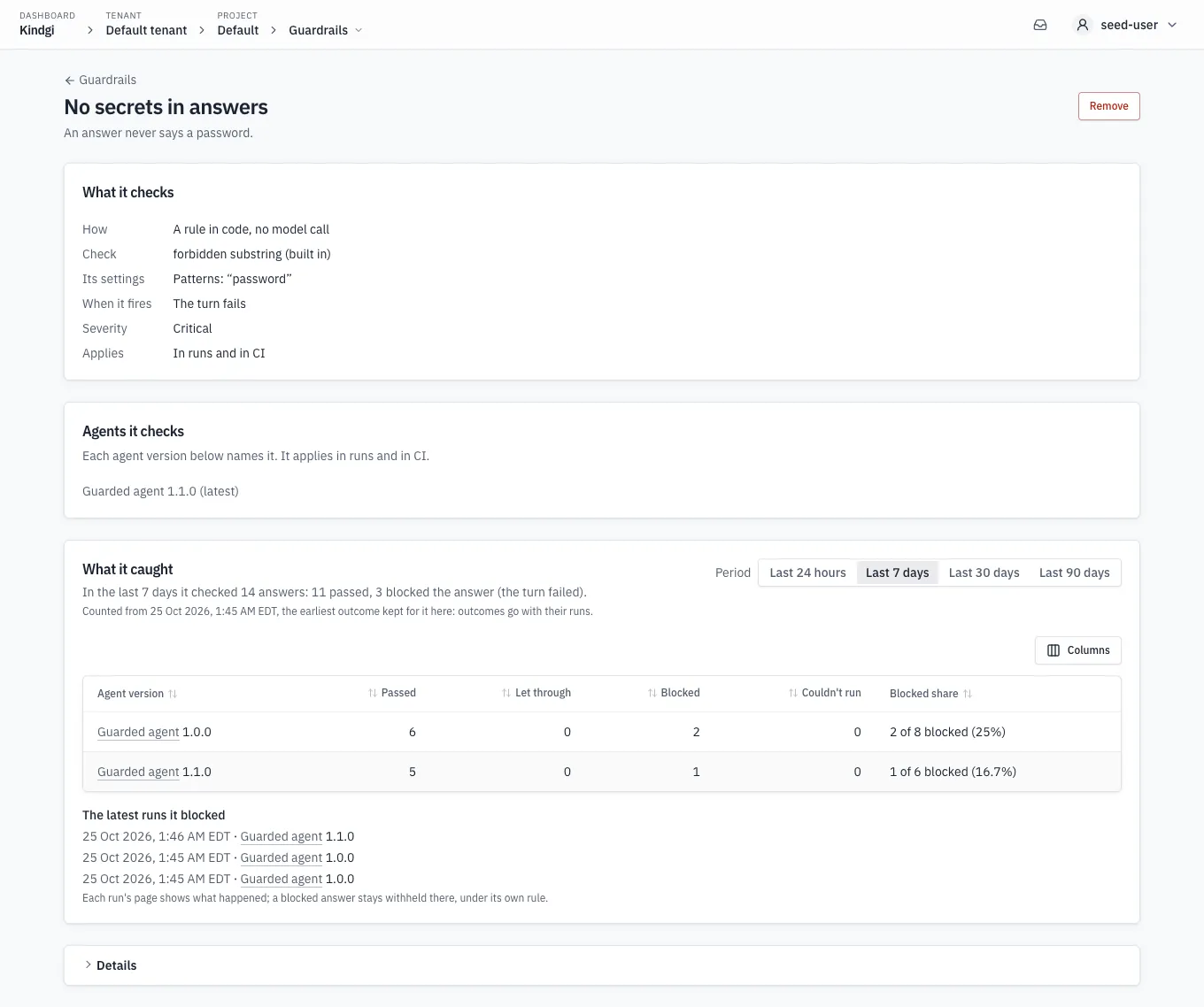
- The sentence counts the answers it checked in the window, by outcome:
"passed", "found something without stopping the turn" (
violated), "blocked the answer (the turn failed)" and "couldn't run" (errored). - By agent version: a row for each version, with Let through for
violatedand Couldn't run forerrored, and the blocked share. The agent's name opens its page. The table sorts by a column's header, and Columns chooses which columns it shows. - The latest runs it blocked: each time opens that run's page, where the blocked answer stays withheld.
- When outcomes start later than the window, it says from when it
counted ("Counted from 25 Oct 2026, 1:45 AM EDT, the earliest outcome kept
for it here: outcomes go with their runs."), as
recordedSincedoes. Its times are on your own clock, or UTC (The menu under your name).